Best Dehumidifiers for Basement and Home in 2026: Ranked by Size, Performance, and Value
High indoor humidity isn't just uncomfortable — it fuels mold growth, worsens allergies, and damages your home. We tested and ranked the best dehumidifiers for every space, from wet basements to quiet bedrooms.

Affiliate Disclosure
HomeAirWise participates in the Amazon Associates program and other affiliate partnerships. When you click a product link and make a purchase, we may earn a small commission at no additional cost to you. This helps us maintain the site and continue providing independent research and recommendations. Read our full disclosure.
The EPA recommends keeping indoor relative humidity between 30% and 50%. Above 60%, mold spores that are always present in your air find the moisture they need to germinate — on walls, behind drywall, inside HVAC ducts, and under carpets. Below 30%, you get dry skin, irritated sinuses, and cracked wood. A dehumidifier is the most direct tool for hitting that target range.
But choosing the right unit means understanding pint capacity, coverage area, drainage options, and noise levels — and matching those specs to where you're actually placing the unit. A 50-pint dehumidifier designed for a 4,500 sq ft basement will be overkill — and unnecessarily loud — in a 300 sq ft bedroom. And a small portable unit will run nonstop without making a dent in a chronically damp crawl space.
We evaluated the top-selling dehumidifiers across every major size category, factoring in real-world extraction rates, noise levels, energy efficiency, and ease of use. Here are the four we recommend in 2026.
Why Humidity Control Matters
Most homeowners don't think about their basement humidity until they smell something musty — and by that point, mold is likely already growing. According to the CDC, mold exposure can trigger nasal congestion, throat irritation, coughing, and eye irritation in otherwise healthy people, and more serious respiratory effects in those with asthma or mold allergies.
Beyond health, excess moisture does structural damage. It warps wood framing, corrodes metal pipes, causes paint to peel, and degrades insulation. FEMA estimates that water damage — much of it from chronic elevated humidity rather than flooding — accounts for billions in US home damage annually.
The good news: a well-placed dehumidifier running consistently is one of the most cost-effective home health investments you can make. Our complete guide to mold prevention and humidity control covers the full picture, including where mold typically grows first and how to identify it early.
How to Choose the Right Dehumidifier Capacity
Dehumidifier capacity is measured in pints per day (PPD) under a standardized DOE test condition (80°F, 60% relative humidity). Here's a practical sizing guide:
| Space Size | Conditions | Recommended Capacity |
|---|---|---|
| Up to 500 sq ft | Slightly damp (musty smell, some condensation) | 20–30 pints/day |
| 500–1,500 sq ft | Moderately damp (visible moisture on walls) | 30–40 pints/day |
| 1,500–2,500 sq ft | Very damp (standing water history, wet floors) | 40–50 pints/day |
| Over 2,500 sq ft | Any condition | 50 pints/day + continuous drain |
One important note: the DOE updated its testing standards in 2019 to better reflect real-world conditions. A unit previously rated at "70 pints" under the old standard is now rated at roughly "50 pints" under the current standard — the unit didn't change, just the measurement protocol. Don't be misled by older marketing materials comparing "70-pint" and "50-pint" models directly.
Our Top Dehumidifier Picks for 2026
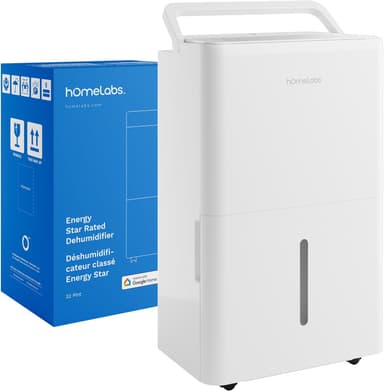
hOmeLabs
hOmeLabs 4,500 Sq Ft Dehumidifier
$249.99
Energy Star certified 50-pint dehumidifier for large spaces up to 4,500 sq ft. Continuous drain option, auto shutoff, digital controls.
- Energy Star certified
- Continuous drain option eliminates emptying
- Large capacity for basements
As an Amazon Associate we earn from qualifying purchases. Prices updated regularly.
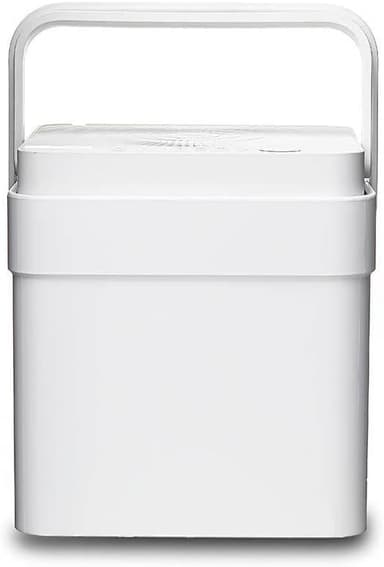
Midea
Midea Cube 50 Pint Smart Dehumidifier
$259.99
A revolutionary 50-pint dehumidifier with a patented lift-and-twist design providing 3× more water tank capacity. ENERGY STAR Most Efficient certified, Wi-Fi enabled, and independently ranked as one of the fastest dehumidifying units ever tested.
- Patented lift-and-twist design with 3× more tank capacity
- Ranked fastest extraction rate in independent testing
- ENERGY STAR Most Efficient certified
As an Amazon Associate we earn from qualifying purchases. Prices updated regularly.
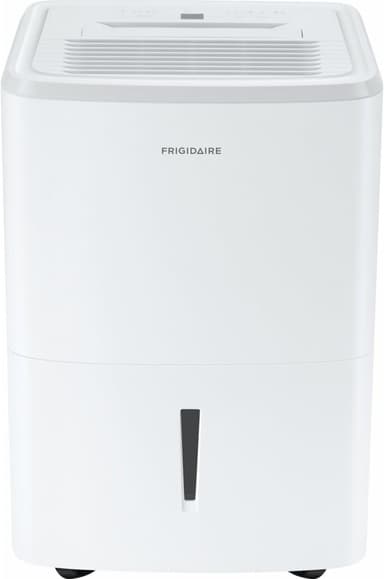
Frigidaire
Frigidaire FFAD5033W1 Dehumidifier
$219.99
50-pint dehumidifier with Effortless™ humidity control. Quiet, reliable, and easy to use for medium to large rooms.
- Trusted Frigidaire brand reliability
- Quiet operation
- Simple, intuitive controls
As an Amazon Associate we earn from qualifying purchases. Prices updated regularly.
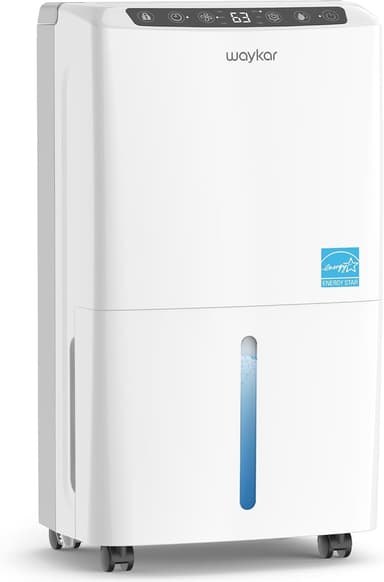
Waykar
Waykar 2000 Sq Ft Energy Star Dehumidifier
$179.99
A compact, ultra-quiet 34-pint ENERGY STAR dehumidifier for bedrooms, bathrooms, and mid-sized living spaces up to 2,000 sq ft. Operates at an impressively quiet 33 dB with continuous drain hose included.
- Ultra-quiet at 33 dB — suitable for bedrooms
- 2025 ENERGY STAR Most Efficient certified
- Includes 6.5-ft drain hose for continuous operation
As an Amazon Associate we earn from qualifying purchases. Prices updated regularly.
Key Features to Look For
Continuous Drain (Auto-Drain) Capability
Every dehumidifier has an internal water collection tank that will fill and trigger an auto-shutoff — usually within 12–24 hours during peak summer humidity. For unattended operation (especially in basements), a continuous drain hose connection is non-negotiable. All four of our recommended models support gravity drain via a standard garden hose connection. The Midea Cube additionally includes a built-in pump for pumping water uphill to a sink or window — useful when you can't gravity-drain to a floor drain.
ENERGY STAR Certification
A 50-pint dehumidifier running 12 hours per day uses roughly 500–700 watts. Over a humid 4-month season, that's 60–80 kWh per month added to your electricity bill. ENERGY STAR certified units consume at least 15% less energy than non-certified models at the same capacity — the Midea Cube's "Most Efficient" certification represents the top tier. Over a 5-year lifespan, this difference can amount to $150–$300 in electricity savings.
Operating Temperature Range
Standard refrigerant-based dehumidifiers — all four of our picks — stop working effectively below about 41°F (5°C). If your basement or crawl space drops below this in winter, the compressor will struggle and ice may form on the coils. For unheated cold spaces, look for a desiccant dehumidifier instead, which works at temperatures as low as 32°F and below. If your basement stays above 50°F year-round, any of our recommended units will work fine.
Noise Level
Noise is rarely a concern for basement dehumidifiers, but it matters if you're placing a unit in or near a bedroom. Standard 50-pint dehumidifiers operate at around 50–55 dB — roughly equivalent to a normal conversation. The Waykar 2000 Sq Ft is the outlier here at 33 dB, making it the only unit on our list we'd genuinely describe as "bedroom quiet." Learn more about how indoor air quality affects your sleep quality and daytime productivity.
Where to Place Your Dehumidifier
Placement makes a significant difference in performance. Follow these guidelines:
- Center of the space — Avoid placing it flush against walls or in corners, which restricts airflow. Allow at least 12 inches of clearance on all sides.
- Near the moisture source — If you have one particularly damp wall or window, position the unit closer to that side of the room.
- Off the floor if possible — Placing the unit on a low shelf or platform (6–12 inches off the floor) improves intake airflow and simplifies drain hose routing.
- Away from cold exterior walls — In winter, the air near exterior walls is cooler and may be below the unit's operating temperature even if the room average is fine.
- Keep doors and windows closed — Running a dehumidifier with open windows or doors is like trying to bail out a boat with the plug still out. The unit will run continuously without achieving your target humidity.
If you're dealing with mold that's already appeared, dehumidification is a key part of remediation — but first read our guide on how to reduce indoor humidity and prevent mold for a complete remediation-and-prevention strategy.
Signs You Need a Dehumidifier Now
Not sure if your home actually needs one? Watch for these indicators:
- Musty or earthy smell anywhere in the home — especially in the basement, bathroom, or closets. This is the smell of active mold or mildew.
- Condensation on windows, especially on the lower portion of windows during mild weather.
- Visible dark spots or discoloration on ceilings, walls, or grout — early-stage mold growth.
- Allergy or asthma symptoms that improve when you leave home — a strong signal that indoor air quality is affecting you. See our full breakdown of signs your indoor air quality is affecting your health.
- Wood floors or furniture that feel sticky — high humidity causes wood to absorb moisture and swell.
- Humidity readings above 60% on a hygrometer or air quality monitor.
Frequently Asked Questions
How long should I run my dehumidifier each day?
During summer months in a damp basement, you may need to run it 12–16 hours per day — or even continuously — until you bring humidity down to the 45–50% range. Once you've reached your target, most units will cycle on and off automatically to maintain it. In winter, many basements naturally stay dry and you may not need the unit at all.
Should I run a dehumidifier in winter?
In most climates, no. Cold outdoor air is naturally dry, and your home's heating system further reduces indoor humidity. Running a dehumidifier in winter can make your home uncomfortably dry. An exception: if you have a chronically wet basement from groundwater intrusion regardless of season, a dehumidifier may be needed year-round.
Where should I set the humidity level?
The 45–50% relative humidity sweet spot is ideal for most homes. Below 30% causes discomfort (dry skin, irritated sinuses, cracked wood). Above 60% is where mold becomes an active risk. During summer, aim to keep all occupied spaces below 55% at a minimum.
Do I need a dehumidifier if I already have central air conditioning?
Possibly. Central AC does dehumidify the air it cools, but it only covers conditioned spaces — not basements, crawl spaces, or attached garages. If your basement stays noticeably more humid than your main floor, a dedicated dehumidifier for that space will perform better than relying on the AC system alone.
How often do I need to clean my dehumidifier?
Clean the water collection tank every 2–4 weeks with warm water and mild soap to prevent mold or bacterial growth inside the tank itself. Clean or replace the air filter every 3 months. Wipe down the exterior grilles annually to remove dust buildup that reduces airflow efficiency.
Bottom Line
For most homeowners with a damp basement or crawl space, the hOmeLabs 4,500 Sq Ft Dehumidifier offers the best balance of capacity, reliability, and value. Set it up with the continuous drain hose connected to your floor drain, dial in 50% humidity, and largely forget about it.
If you value smart home integration and the fastest extraction rate available, the Midea Cube is worth the slight price premium. For a bedroom or second-floor space where noise matters most, the ultra-quiet Waykar 2000 Sq Ft is the clear choice. And if brand heritage and simple controls are your priority, Frigidaire delivers.
Have questions about which dehumidifier fits your specific situation? Our editorial team is happy to help — describe your space and we'll point you in the right direction. You can also explore our full dehumidifier product reviews for detailed side-by-side specs and user ratings.