Best Indoor Air Quality Monitors for Your Home in 2026: Complete Buying Guide
You can't see PM2.5, CO2, or VOCs — but they're shaping your health every day. We compared the top indoor air quality monitors on accuracy, sensors, and value to help you pick the right one for your home.

Affiliate Disclosure
HomeAirWise participates in the Amazon Associates program and other affiliate partnerships. When you click a product link and make a purchase, we may earn a small commission at no additional cost to you. This helps us maintain the site and continue providing independent research and recommendations. Read our full disclosure.
Most people can tell when their home is too hot, too cold, or too loud. But the pollutants that matter most for your health — fine particulate matter (PM2.5), carbon dioxide (CO2), volatile organic compounds (VOCs), and radon — are completely invisible and odorless. You could be breathing elevated levels right now without any sensory cue at all.
An indoor air quality monitor changes that. It turns invisible risk into a number you can act on: open a window, run your air purifier, switch cleaning products, or schedule radon testing. But not all monitors measure the same things, and the differences in sensor quality, accuracy, and connectivity are significant enough to matter. We compared the leading consumer models to help you choose the right one for your needs and budget.
What Air Quality Monitors Actually Measure
Before comparing devices, it helps to understand what each sensor is actually telling you:
- PM2.5 (fine particulate matter) — Microscopic particles 2.5 micrometers or smaller, small enough to penetrate deep into your lungs and bloodstream. Sources include cooking, candles, fireplaces, smoking, and outdoor pollution (including wildfire smoke) that infiltrates indoors. The EPA considers levels above 35 μg/m³ (24-hour average) unhealthy.
- CO2 (carbon dioxide) — A direct indicator of ventilation. Outdoor air is around 420 ppm; indoor levels above 1,000 ppm signal inadequate fresh-air exchange and are linked to drowsiness, headaches, and reduced cognitive performance. Our guide on how CO2 levels affect sleep and productivity covers this in depth.
- VOCs (volatile organic compounds) — Gases released from paints, furniture, cleaning products, air fresheners, and new building materials. Some VOCs are merely irritating; others are linked to long-term health effects. Read our complete guide to understanding VOCs in your home for a full breakdown of common sources.
- Radon — A radioactive gas that seeps from soil into homes through foundation cracks. It's the second-leading cause of lung cancer in the US after smoking. Very few consumer monitors measure it accurately — the Airthings View Plus below is a notable exception. Learn more in our guide to what radon is and why every home should be tested.
- Humidity and temperature — Standard on nearly every monitor. Humidity above 60% creates conditions for mold growth (see our mold prevention guide), while extremes in either direction affect comfort and respiratory health.
How to Choose the Right Monitor
Match the device to your actual concern rather than buying the one with the most sensors:
- General awareness on a budget — A monitor that tracks PM2.5, CO2, VOCs, humidity, and temperature with a simple color-coded display is enough to flag problems and prompt action.
- Smart home integration — If you already use Alexa or Google Home, a monitor with native voice assistant integration lets you set automations (e.g., "turn on the air purifier when PM2.5 rises").
- Comprehensive, ongoing tracking — If you want one device to cover everything including radon, a multi-sensor flagship unit with a persistent display and historical trend data is worth the investment.
- Precision and documentation — If you need quantitative data for HVAC assessment, a rental dispute, or simply want lab-grade accuracy you can export and analyze, a professional-grade portable analyzer is the right tool.
Our Top Picks for 2026
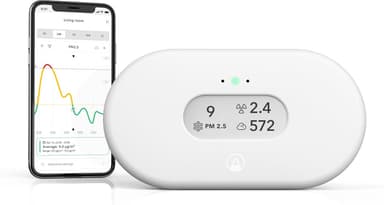
Airthings
Airthings View Plus
$299.99
The most comprehensive home air quality monitor available. Tracks radon, PM2.5, CO2, VOCs, humidity, temperature, pressure, and more.
- 7 sensors including radon AND PM2.5 (rare combination)
- Built-in e-ink color display
- Wi-Fi with real-time app access
As an Amazon Associate we earn from qualifying purchases. Prices updated regularly.
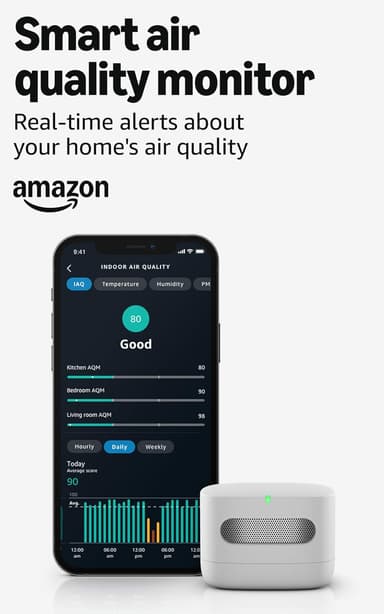
Amazon
Amazon Smart Air Quality Monitor
$69.99
An affordable Alexa-integrated indoor air quality monitor that tracks PM2.5, CO, humidity, temperature, and VOCs in real-time with color-coded display and smart home automation.
- Deep Alexa integration with voice queries and notifications
- Tracks PM2.5, CO, humidity, temperature, and VOCs
- Color-coded LED display for at-a-glance status
As an Amazon Associate we earn from qualifying purchases. Prices updated regularly.
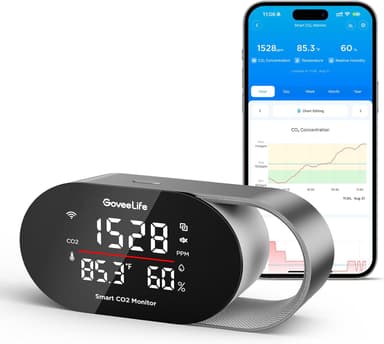
Govee
Govee Air Quality Monitor
$49.99
Budget-friendly indoor air quality monitor tracking PM2.5, CO2, TVOC, temperature, and humidity with a large color display.
- Very affordable for multi-sensor monitoring
- Large, clear color display
- Bluetooth app with historical data
As an Amazon Associate we earn from qualifying purchases. Prices updated regularly.
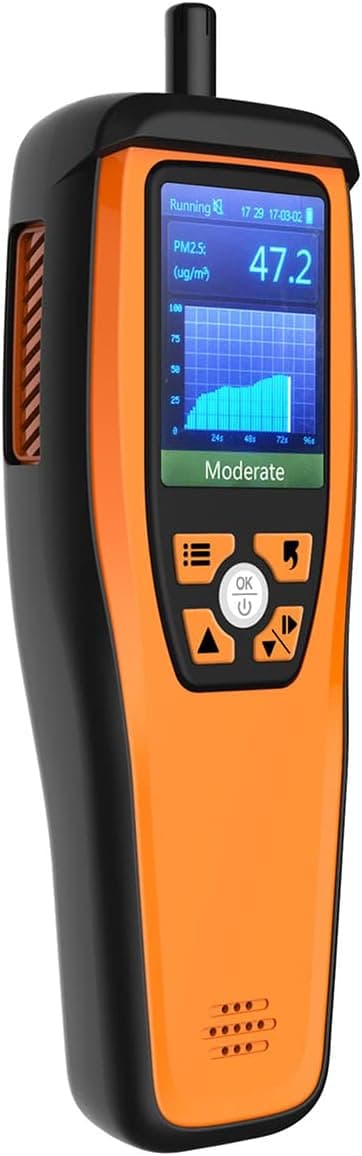
Temtop
Temtop M2000C 2nd Gen Air Quality Monitor
$129.99
A professional-grade portable air quality analyzer measuring CO2, PM2.5, PM10, temperature, and humidity with data export capability. Ideal for HVAC professionals, IAQ consultants, and homeowners who need quantitative indoor air data.
- Professional NDIR CO2 sensor — accurate and long-lasting
- Measures 6 parameters: CO2, PM2.5, PM10, HCHO, temp, humidity
- Data logging with PC export for professional documentation
As an Amazon Associate we earn from qualifying purchases. Prices updated regularly.
How to Interpret Your Readings
Once your monitor is running, here's a quick reference for what the numbers mean:
| Pollutant | Good | Moderate — Take Action | Unhealthy — Act Now |
|---|---|---|---|
| PM2.5 (μg/m³) | 0–12 | 12–35 | Above 35 |
| CO2 (ppm) | Below 800 | 800–1,000 | Above 1,000 |
| TVOC (ppb) | Below 220 | 220–660 | Above 660 |
| Radon (pCi/L) | Below 2.0 | 2.0–4.0 | Above 4.0 (EPA action level) |
| Relative Humidity | 30–50% | 50–60% | Above 60% or below 25% |
If your monitor consistently flags elevated PM2.5 or VOCs, the most effective fix is usually a quality HEPA air purifier — see our guide to choosing the right HEPA air purifier and our 2026 rankings of the best air purifiers for allergies. If CO2 readings spike in occupied rooms, the fix is usually as simple as cracking a window or running an exhaust fan — your body and mind will notice the difference within minutes.
Where to Place Your Monitor
Placement affects what your monitor actually tells you:
- Bedrooms — Place at approximately head height near your bed (but not directly against a wall) to capture what you're actually breathing for 7–8 hours each night. This is the single most valuable placement for most households.
- Living areas / kitchens — Position away from direct cooking exhaust to avoid skewed PM2.5 spikes, but close enough to catch general trends from daily activity.
- Avoid direct sunlight, drafts from doors and windows, and spots directly above heating vents — all of which distort temperature and humidity readings.
- Multiple units — If your budget allows, placing monitors on different floors (especially if you have a basement) gives you a far more complete picture, since air quality often varies significantly room to room. Our guide to complete home air quality testing covers a room-by-room testing strategy in detail.
Frequently Asked Questions
Do I need a separate radon detector if my monitor already measures it?
If your monitor uses a validated, continuously-calibrated radon sensor (like the Airthings View Plus), it can serve as your ongoing radon monitor. However, for real estate transactions or definitive baseline testing, an EPA-recognized lab test or NRPP-certified continuous monitor is still recommended — see our roundup of the best radon detectors for dedicated options.
How accurate are consumer-grade air quality monitors?
Consumer monitors using laser-scattering PM2.5 sensors and NDIR CO2 sensors (like the Temtop M2000C) are generally accurate within 10–15% of professional reference instruments — more than precise enough to identify trends and trigger action. Cheaper electrochemical or MOS-based sensors (common in budget VOC and CO2 sensors) drift more over time and are best used for relative trends rather than absolute readings.
Will a monitor alone improve my air quality?
No — a monitor only measures and reports. It's the first step that tells you when and where to act: open a window, run an air purifier, switch a cleaning product, or call in a radon mitigation contractor. Think of it as the dashboard, not the engine.
How long does it take to get a baseline reading?
Most particulate, CO2, and VOC sensors begin reporting within minutes, but it typically takes 24–48 hours of normal household activity to establish a reliable baseline — capturing your typical cooking, cleaning, and ventilation patterns across a full day-night cycle. Radon sensors require longer: typically 7+ days for a stable reading, since radon levels naturally fluctuate with weather, soil conditions, and HVAC operation.
Can I rely on my smart thermostat's built-in air quality sensor instead?
Built-in sensors on thermostats and smart speakers are typically limited to one or two parameters (often just humidity or a generic "air quality index") and use lower-cost sensors optimized for cost rather than accuracy. A dedicated monitor will give you more actionable, granular data across more pollutants.
Bottom Line
If you want the most complete picture — including radon, which most monitors skip entirely — the Airthings View Plus is the clear top pick despite its higher price. If you're invested in the Alexa ecosystem and want smart-home automation triggered by air quality events, the Amazon Smart Air Quality Monitor offers excellent value at $69.99. Budget-conscious buyers who want solid multi-sensor coverage should look at the Govee Air Quality Monitor. And if you need lab-grade precision with data export for documentation or professional assessment, the Temtop M2000C is purpose-built for that job.
Whichever you choose, the most important step is simply starting to measure. Once you can see what's actually in your air, the path to improving it becomes much clearer. Have questions about which monitor fits your home? Reach out to our editorial team — we're happy to help you decide. You can also browse our full air quality monitor reviews for detailed specs and side-by-side comparisons.