Best Air Purifiers for Pet Owners in 2026: How to Control Dander, Hair, and Odors
Pet dander is one of the most persistent indoor allergens — and it stays airborne far longer than most people realize. Here's how to choose the right HEPA air purifier for a home with dogs, cats, or both.

Affiliate Disclosure
HomeAirWise participates in the Amazon Associates program and other affiliate partnerships. When you click a product link and make a purchase, we may earn a small commission at no additional cost to you. This helps us maintain the site and continue providing independent research and recommendations. Read our full disclosure.
If you share your home with a dog, a cat, or — as roughly 70% of American households do — more than one pet, your indoor air carries a load that pet-free homes simply don't. Pet dander, saliva proteins, fur fibers, and the volatile organic compounds behind that distinctive "pet smell" combine into a persistent airborne cocktail that standard HVAC filters weren't designed to handle. According to the American College of Allergy, Asthma & Immunology (ACAAI), pet allergens are detected in virtually 100% of U.S. homes — including homes that have never housed a pet — because the particles are so small and sticky that they travel on clothing and settle into soft furnishings.
A well-chosen air purifier won't replace regular grooming, vacuuming, or washing pet bedding. But it addresses the part of the problem those habits can't: the microscopic dander and odor compounds that remain suspended in your breathing zone for hours after your pet leaves the room. This guide explains exactly what you're dealing with, what features actually matter for pet households, and which purifiers we'd buy in 2026.
What Pet Dander, Hair, and Odors Actually Are
Understanding the enemy helps you pick the right weapon. Pet-related air quality problems come from three distinct sources, and each requires a different filtration approach.
Dander
Pet dander consists of microscopic flakes of dead skin shed by dogs, cats, rodents, and birds. Individual dander particles range from 2.5 to 10 microns in diameter — small enough to remain airborne for hours and penetrate deep into the lungs. The allergenic proteins (Fel d 1 in cats, Can f 1 in dogs) are actually even smaller: they bind to particles as fine as 0.1–1 micron, which is why they can stay suspended indefinitely in still air. Cat allergens are particularly tenacious — studies published in the Journal of Allergy and Clinical Immunology have found Fel d 1 detectable in homes up to six months after a cat was removed.
Hair and fur
Pet hair itself isn't an allergen — it's the dander, saliva, and urine proteins clinging to the hair that trigger reactions. But loose fur is a major transport mechanism. A single medium-haired dog can shed enough fur daily to visibly coat a dark couch within hours. The primary filtration concern with pet hair is that it accumulates rapidly on pre-filters and, if not managed, reduces the airflow and efficiency of the main HEPA filter behind it. Purifiers with washable or easily replaceable pre-filters are significantly more practical in pet households.
Odors
The "wet dog" smell, litter box odor, and general pet musk are caused by volatile organic compounds — primarily fatty acids, aldehydes, and ammonia-based compounds. These are gaseous molecules, not particles, which means HEPA filters cannot capture them. Odor control requires a separate activated carbon (charcoal) filter layer that adsorbs gas-phase molecules onto its porous surface. The amount of activated carbon matters: a thin carbon sheet will saturate quickly in a pet-heavy home, while a thicker carbon bed or pellet-based filter provides longer-lasting odor control. For a deeper look at the VOC side of indoor air quality, our guide to VOCs in your home covers sources, health effects, and reduction strategies.
What to Look for in an Air Purifier for Pets
Not every air purifier marketed as "good for pets" actually delivers meaningful performance in a real pet household. Here are the features that genuinely matter — and one common marketing claim that doesn't.
True HEPA filtration (non-negotiable)
A True HEPA filter (also labeled H13 HEPA) captures 99.97% of particles at 0.3 microns — the most penetrating particle size. Since pet dander ranges from 2.5 to 10 microns and allergen-carrying particles go down to ~0.1 microns, True HEPA handles the full spectrum. Avoid anything labeled "HEPA-type," "HEPA-style," or "HEPA-like" — these marketing terms describe filters that may capture only 85–90% of particles and are not held to the same testing standards. Our explainer on what HEPA actually means breaks down why this distinction matters.
A washable or high-capacity pre-filter
In a pet home, the pre-filter does more work than in any other environment. It captures the large visible particles — fur, hair, lint, dust bunnies — before they reach (and clog) the expensive HEPA filter. A washable pre-filter that you can rinse or vacuum every 2–4 weeks will save you significant money over disposable pre-filters, especially with heavy shedders like Labrador Retrievers, German Shepherds, Huskies, or long-haired cats.
Activated carbon for odors
If pet odor is part of your concern — and for most multi-pet households, it is — look for a purifier with a dedicated activated carbon layer. The thicker or more substantial the carbon filter, the longer it will remain effective before needing replacement. Some models use a thin carbon sheet bonded to the HEPA filter; others use a separate replaceable carbon cartridge. The separate cartridge typically lasts longer and performs better for sustained odor loads.
Adequate CADR for your room size
The Clean Air Delivery Rate (CADR) tells you how many cubic feet of air per minute the purifier can clean. For pet households, we recommend sizing up: choose a purifier rated for a room 20–30% larger than your actual space. This ensures the unit can cycle your air frequently enough to keep dander levels low even during active shedding periods. The Association of Home Appliance Manufacturers (AHAM) recommends at least 4–5 air changes per hour for allergy relief — in a pet-heavy environment, aim for the higher end.
What doesn't matter: ionizers and UV-C
Some purifiers include ionizers or UV-C lights marketed as extra pet protection. Ionizers charge particles so they stick to surfaces — which means dander lands on your walls and furniture instead of being captured in a filter (you still have to clean it up). UV-C germicidal lights can neutralize some bacteria, but they have minimal effect on allergens and zero effect on odors. Neither feature replaces good mechanical HEPA + carbon filtration for pet households.
| Feature | Why It Matters for Pets | What to Look For |
|---|---|---|
| True HEPA filter | Captures 99.97% of dander particles (down to 0.3 μm) | H13 HEPA or True HEPA certification |
| Pre-filter | Traps pet hair before it clogs the HEPA filter | Washable or vacuum-cleanable; easy to remove |
| Activated carbon | Adsorbs pet odor VOCs (ammonia, fatty acids) | Separate carbon cartridge or thick pellet-based layer |
| CADR rating | Determines how quickly the unit cycles room air | Match to room size + 20–30% buffer for heavy shedding |
| Auto mode / sensor | Ramps up automatically when pets are active (play, grooming) | Real-time particle sensor with auto fan speed adjustment |
| Noise level | Matters if the purifier runs in a bedroom or pet sleeping area | Under 30 dB in sleep mode; under 55 dB on high |
| Filter replacement cost | Pet homes replace filters faster — annual cost adds up | Check combined annual filter cost (pre-filter + HEPA + carbon) |
Our Top Picks for Pet Owners in 2026
We evaluated air purifiers specifically through the lens of pet ownership: pre-filter design, carbon capacity for odors, CADR relative to common room sizes, and long-term filter replacement costs. Here are the four models we recommend, each for a different situation. For a broader comparison that includes seasonal allergen performance, see our best air purifiers for allergies guide.
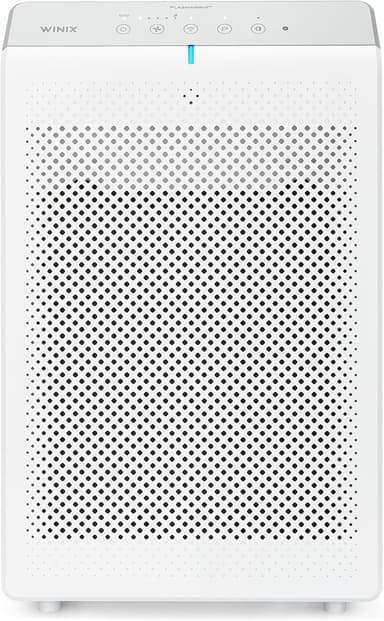
Best Overall for Pet Owners: Winix 5500-2
Winix
Winix 5500-2 Air Purifier
$179.99
True HEPA + washable pre-filter + activated carbon for rooms up to 360 sq ft. Includes PlasmaWave technology.
- Washable pre-filter (lower maintenance cost)
- Strong HEPA + carbon combo
- Auto mode with smart air quality sensor
As an Amazon Associate we earn from qualifying purchases. Prices updated regularly.
The Winix 5500-2 is our top pick for pet owners because it addresses every pet-specific pain point simultaneously. The washable pre-filter is the standout feature: instead of replacing a disposable pre-filter every few months (which you'll burn through quickly with a shedding dog), you simply vacuum or rinse it under water. Over a year, this saves $30–$50 in pre-filter costs alone — and in a two-dog household, those savings compound meaningfully.
The True HEPA filter handles dander and fine allergen particles. The activated carbon filter targets pet odors and VOCs from litter, pet beds, and general animal musk. And the PlasmaWave technology (which can be disabled if you prefer purely mechanical filtration) generates hydroxyl radicals that help break down odor compounds and bacteria — useful if you've ever noticed that lingering wet-dog smell after bath day.
At a CADR of 243 CFM (smoke) and 246 CFM (dust/pollen), the 5500-2 handles rooms up to 360 sq ft at approximately 4.8 air changes per hour. The smart sensor detects air quality changes — like your dog shaking off after a walk — and ramps up automatically. For single-pet or dual-pet households with a primary living space under 350 square feet, this is the most cost-effective long-term solution.
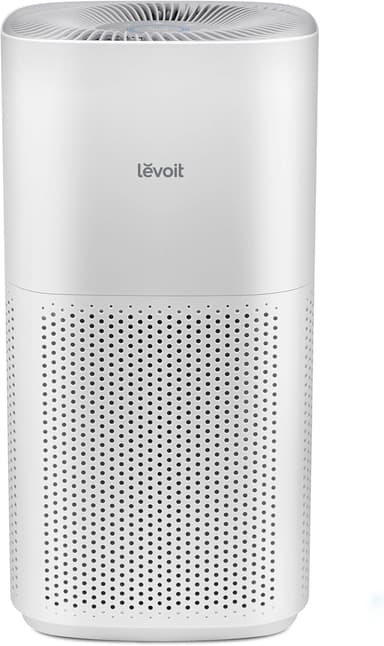
Best for Large Spaces and Multiple Pets: Levoit Core 600S
Levoit
Levoit Core 600S Smart Air Purifier
$279.99
Levoit's most powerful home air purifier for large spaces up to 635 sq ft. With a CADR of 410 CFM, built-in laser PM2.5 sensor, and auto-mode intelligence, the Core 600S is the go-to for open-plan living rooms and large bedrooms.
- 410 CFM CADR — covers up to 635 sq ft per cycle
- Built-in laser PM2.5 sensor for auto-mode intelligence
- True H13 HEPA with pet-allergen pre-filter
As an Amazon Associate we earn from qualifying purchases. Prices updated regularly.
If you have an open-floor-plan living room, multiple pets, or both, the Levoit Core 600S delivers the raw air-moving power that smaller purifiers can't match. With a CADR of 410 CFM, it cleans a 635 sq ft room every 12.5 minutes — fast enough to keep up with three dogs wrestling on the living room rug.
The ARC Formula filter system includes a pet-allergen pre-filter specifically designed for animal hair and dander, a True H13 HEPA layer, and an activated carbon filter optimized for pet odors and smoke. The built-in laser PM2.5 sensor provides genuinely accurate real-time readings — not the approximation you get from cheaper optical sensors — and the auto mode responds intelligently to air quality events. Cook dinner while the dog tracks in pollen from the yard? The 600S ramps up automatically and drops back to whisper mode once the air clears.
The VeSync app provides 30-day air quality history, which is useful for identifying patterns — you might discover that air quality dips every Tuesday when your pet sitter lets the dog in from a muddy yard. The main trade-off is price ($280) and replacement filter cost (~$40 every 6–8 months), but for large spaces where a smaller unit would need to run at max speed constantly, the 600S is the more efficient choice.
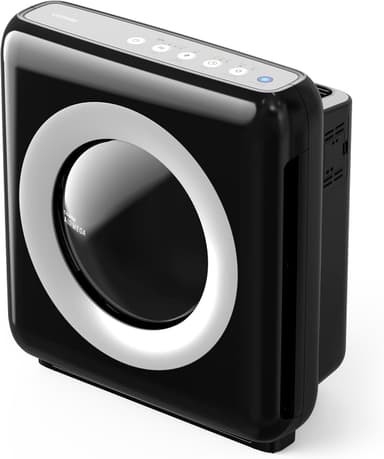
Best Value: Coway AP-1512HH Mighty
Coway
Coway AP-1512HH Mighty Air Purifier
$89.99
Best-selling 4-stage filtration air purifier for rooms up to 360 sq ft. True HEPA + activated carbon + ionizer.
- Exceptional value for HEPA filtration
- Auto mode with real air quality sensing
- Quiet operation (sleep mode)
As an Amazon Associate we earn from qualifying purchases. Prices updated regularly.
The Coway Mighty has been a top-rated air purifier for years, and for pet owners on a budget, it still delivers remarkable performance relative to its price. The 4-stage filtration starts with a pre-filter that catches hair and large dander, moves through activated carbon for odors, then a True HEPA filter for fine particles, and finishes with an optional ionizer.
The air quality indicator — the colored LED ring on the front — responds in real time to airborne particle changes. You'll notice it shift from blue (clean) to purple or red when you brush your cat nearby, which is both reassuring and instructive: it demonstrates just how much dander grooming releases into the air. At a CADR of 240 CFM for rooms up to 360 sq ft, it provides solid coverage for a bedroom, home office, or medium living room.
The trade-off versus the Winix 5500-2 is that the Coway's pre-filter, while cleanable, isn't as robustly washable — and the carbon filter is thinner, so it may saturate faster in heavy-odor situations (multiple cats, large dogs). But at roughly half the price of the Levoit 600S, the Coway Mighty is the right entry point for pet owners who want proven HEPA performance without a large upfront investment.
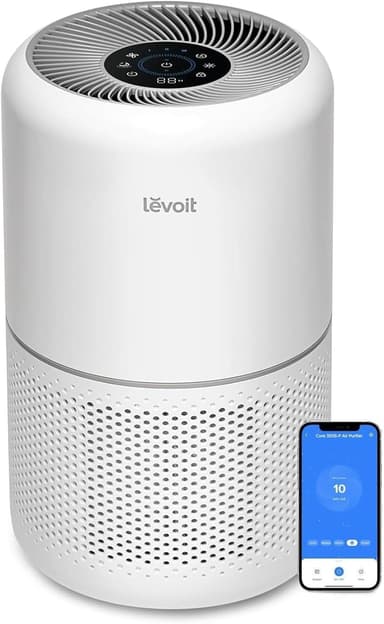
Best Compact Option: Levoit Core 300S
Levoit
Levoit Core 300S Smart Air Purifier
$99.99
Amazon's #1 bestselling air purifier with over 100,000 five-star reviews. True H13 HEPA filters 99.97% of 0.3-micron particles for rooms up to 219 sq ft, with whisper-quiet sleep mode and VeSync app control.
- Amazon's #1 bestselling air purifier with 100K+ reviews
- True H13 HEPA removes 99.97% of 0.3-micron particles
- Whisper-quiet at 24 dB in sleep mode
As an Amazon Associate we earn from qualifying purchases. Prices updated regularly.
For a bedroom where the dog sleeps, a home office where the cat perches on your desk, or any room under 220 sq ft, the Levoit Core 300S is a compelling choice. Amazon's bestselling air purifier — with over 100,000 ratings — it delivers True H13 HEPA filtration in a compact cylindrical design that fits on a nightstand.
The 360-degree air intake means placement is flexible: you don't need to worry about keeping the back or sides clear of furniture, which is helpful in tight spaces. The sleep mode drops noise to 24 dB — quieter than a whisper — so it won't disturb light sleepers or anxious pets. And the VeSync app lets you set schedules, check filter life, and control the unit from anywhere.
The limitation is coverage: at 219 sq ft max (with CADR ratings of 141–149 CFM), the Core 300S isn't enough for a large living room with multiple pets. Think of it as a targeted solution for the rooms where you and your pets spend the most concentrated time — a bedroom purifier, not a whole-home solution. For whole-home strategies that combine room-level purification with other approaches, see our complete guide to home air quality testing.
Room-by-Room Placement Tips for Pet Owners
Where you place your air purifier matters almost as much as which one you buy. Pet dander doesn't distribute evenly — it concentrates where pets spend time, and airflow patterns either help or hinder the purifier's reach.
Living room / family room
This is usually where pets are most active during the day. Place the purifier within 6–8 feet of where your pet typically rests or plays, but not directly behind furniture that would block airflow. If the room is open to a kitchen or hallway, size up — the effective volume is larger than the room's footprint suggests. The Levoit Core 600S or Winix 5500-2 are strong choices here.
Bedroom
If your pet sleeps in the bedroom (as roughly 56% of pet owners allow, according to the American Pet Products Association), this room deserves its own purifier. Position it 3–6 feet from the bed on the side closest to where the pet sleeps — whether that's a dog bed on the floor or the foot of the mattress. Prioritize sleep-mode noise levels: anything under 28 dB is effectively inaudible. The Levoit Core 300S excels here.
Home office
Cats, in particular, tend to claim office spaces — desk tops, keyboard trays, and desk chairs are prime napping territory. A compact purifier on or near the desk targets the allergens right where you're breathing them. If you're noticing signs that poor air quality is affecting your concentration or health, this is often the highest-impact room to address.
Near the entry door
Dogs bring outdoor allergens in on their fur after every walk — pollen, mold spores, dust, and soil particles. If your home's layout allows it, positioning a purifier near the main entry point catches those hitchhiking allergens before they circulate through the rest of the house. This is especially valuable during high-pollen seasons (spring and fall) when outdoor particles compound the indoor pet allergen load.
Maintenance Tips: Getting the Most From Your Purifier in a Pet Home
Air purifiers in pet households work harder than in pet-free homes, which means filters wear out faster and maintenance matters more. Follow these guidelines to keep performance optimal.
- Clean the pre-filter every 2–4 weeks — not the 1–3 months most manufacturers recommend. Pet hair accumulates rapidly, and a clogged pre-filter restricts airflow to the HEPA filter, reducing overall efficiency. Vacuum it first, then rinse if it's washable.
- Replace HEPA filters on schedule — or sooner. Most HEPA filters are rated for 6–12 months, but in high-dander environments, you may notice reduced airflow or a persistent odor before that point. If your unit has a filter-life indicator, trust it; if it doesn't, mark your calendar.
- Don't forget the carbon filter. Activated carbon saturates — once it's full, it stops adsorbing odors entirely. In a multi-pet home, carbon filters may need replacing every 3–4 months rather than the 6-month manufacturer recommendation.
- Run the purifier 24/7 on auto mode, not just when you're home. Dander and odors accumulate continuously, and most modern purifiers in auto mode draw very little power (15–30 watts) at low fan speeds. Turning it off and on creates cycles where allergen levels spike and the unit has to work much harder to catch up.
- Pair with regular vacuuming. An air purifier handles airborne particles; a vacuum with a sealed HEPA bag handles settled dander in carpets and upholstery. Together, they reduce total allergen exposure far more effectively than either alone. Vacuum high-traffic pet areas at least twice a week.
Frequently Asked Questions
Do air purifiers really help with pet allergies?
Yes — clinical evidence supports it. A 2018 review in the Journal of Allergy and Clinical Immunology: In Practice found that HEPA air purifiers significantly reduced airborne pet allergen concentrations in controlled studies. They're most effective as part of a multi-pronged approach: HEPA purifier + regular vacuuming with a HEPA-sealed vacuum + washing pet bedding weekly + keeping pets out of the bedroom (if possible). The purifier alone won't eliminate symptoms, but it meaningfully reduces the airborne allergen load your immune system has to deal with.
Can an air purifier eliminate pet odors completely?
It can reduce them substantially, but "completely" depends on the source. An activated carbon filter adsorbs the VOCs that cause pet odors — and for moderate odor loads (one or two well-groomed pets), a good carbon filter makes a noticeable difference within hours. For heavy odor sources (uncleaned litter boxes, multiple large dogs, urine-soaked carpet padding), no air purifier will fully solve the problem — you need to address the source directly. Think of the purifier as managing the ongoing ambient odor, not compensating for a chronic hygiene gap.
How often should I replace filters in a pet household?
Plan on roughly 30–50% shorter filter life than the manufacturer's stated interval. Pre-filters in a two-dog home may need cleaning every 2 weeks and replacing (if disposable) every 2–3 months. HEPA filters typically last 6–9 months instead of the stated 12. Carbon filters may need swapping every 3–4 months instead of 6. Annual filter costs for pet owners typically run $80–$150 depending on the purifier model — budget for this when comparing upfront prices.
Is one air purifier enough for a whole house with pets?
Generally, no. Air purifiers are room-level devices — they clean the air in the space where they're placed, not through walls and closed doors. If your pets roam the entire house, you'll get better results with two or three strategically placed units (one in the living room, one in the bedroom) than with one oversized unit in a single room. The exception is a very small apartment or a home with an open floor plan where one high-CADR unit (like the Levoit Core 600S at 410 CFM) can effectively serve the connected space.
Should I get an air purifier or an air quality monitor first?
If you already know you have pets and allergies, go straight to the purifier — the problem is well-defined. An air quality monitor becomes more valuable once you have a purifier running: it lets you verify the purifier is actually reducing particle levels, identify problem times of day, and optimize placement. Some purifiers (like the Levoit Core 600S) have built-in PM2.5 sensors that serve this dual purpose. For standalone monitors, our best air quality monitors guide covers the options.
Do HEPA purifiers help with pet hair on furniture?
Not directly. HEPA purifiers capture airborne particles, not hair that has already settled onto surfaces. However, they do reduce the amount of fine dander and allergen-carrying particles that would otherwise settle alongside the hair. For the visible hair problem, a lint roller, vacuum with a pet-hair attachment, or washable furniture covers are the practical solutions. The air purifier handles the invisible part — the microscopic dander and allergen proteins that you breathe in.
The Bottom Line
Pet ownership and clean indoor air aren't mutually exclusive — they just require the right tool. For most pet households, the Winix 5500-2 hits the optimal balance: its washable pre-filter saves real money when you're pulling dog hair out of it every two weeks, the True HEPA + activated carbon combination handles both dander and odors, and the 360 sq ft coverage suits most living rooms and bedrooms. If you have a larger open-plan space or multiple pets generating more dander than a single mid-range unit can handle, the Levoit Core 600S delivers the airflow power to keep up — its pet-specific pre-filter and laser PM2.5 sensor justify the higher price for serious pet households.
For budget-conscious buyers, the Coway AP-1512HH Mighty remains one of the best-performing HEPA purifiers at any price and handles a single pet in a medium room without breaking a sweat. And for targeted bedroom or small-room use — especially if your dog or cat sleeps in the room with you — the Levoit Core 300S delivers whisper-quiet H13 HEPA filtration in a compact package that won't take up valuable floor space.
Whichever model you choose, remember that the purifier is most effective as part of a routine: regular grooming, frequent vacuuming with a HEPA-sealed vacuum, and washing pet bedding weekly. The air purifier handles what those habits can't — the invisible, airborne allergens that linger in your breathing zone long after your pet has moved to the next room.