Dehumidifier vs. Air Purifier: Which One Does Your Home Actually Need?
Both devices improve your home environment, but they solve completely different problems. Here's the straightforward guide to figuring out which one — or whether you need both.

Affiliate Disclosure
HomeAirWise participates in the Amazon Associates program and other affiliate partnerships. When you click a product link and make a purchase, we may earn a small commission at no additional cost to you. This helps us maintain the site and continue providing independent research and recommendations. Read our full disclosure.
Walk into any home improvement store and you'll find dehumidifiers and air purifiers sitting side by side on the shelf, often marketed in nearly identical terms — cleaner air, healthier home, better breathing. But these two appliances address entirely different problems. Buy the wrong one and you might spend $200 to $400 on a device that does nothing for your actual situation.
This guide cuts through the confusion. We'll explain exactly what each device does (and what it doesn't do), give you a clear framework for diagnosing your home's specific problem, and recommend specific models for each use case. The bottom line up front: if your issue is excessive moisture, musty smells, or visible condensation, you need a dehumidifier. If your issue is airborne particles, allergens, dust, smoke, or VOCs, you need an air purifier. Many homes benefit from both — but for different reasons.
Two Devices, Two Completely Different Jobs
The confusion between these products is understandable because both are sometimes described as making your air "cleaner" or "healthier." But they operate on different physical principles and address different root causes.
A dehumidifier works by pulling air over a cold coil, causing moisture to condense and drip into a collection tank or drain hose. The drier air is then returned to the room. Dehumidifiers don't filter particles — they remove water vapor. Their whole job is humidity control, and they're extremely effective at it. A properly sized dehumidifier can lower a basement's relative humidity from 75% down to the EPA's recommended range of 30–50% within hours.
An air purifier moves air through one or more filters — typically a pre-filter for large particles, a True HEPA filter (which captures 99.97% of particles 0.3 microns and larger), and often an activated carbon layer for gases and odors. Air purifiers don't touch humidity at all. Their job is removing airborne solids and some gases from circulating air.
| Feature | Dehumidifier | Air Purifier |
|---|---|---|
| Primary function | Remove excess moisture from air | Filter airborne particles and gases |
| Targets | Water vapor, humidity | Dust, allergens, smoke, mold spores, VOCs |
| Prevents | Mold growth, dust mite infestations, structural moisture damage | Airborne irritants from reaching lungs |
| Does NOT address | Particles, allergens, smoke, gases already airborne | Humidity, moisture, conditions that cause mold growth |
| Key metric | Pints/day capacity (room size-dependent) | CADR rating (Clean Air Delivery Rate) and sq ft coverage |
| Typical cost | $150–$350 for whole-room units | $80–$350 for room purifiers |
| Maintenance | Empty tank or connect drain hose; clean filter every few months | Replace HEPA filter every 6–12 months; pre-filter monthly |
| Energy use | Moderate to high (look for Energy Star) | Low to moderate (CADR/watt varies) |
Signs You Need a Dehumidifier
Humidity problems in the home have distinct signatures. If you recognize several of these, a dehumidifier is your answer — and an air purifier, however good, will not help.
Visible and physical signs
- Condensation on windows or cold pipes — especially in winter, when warm indoor air meets cold glass. This is one of the clearest indicators that your indoor relative humidity is above 50–55%.
- Musty odors in basements, crawl spaces, bathrooms, or closets. Musty smell is a direct byproduct of mold and mildew growth, which requires sustained relative humidity above 60% to establish.
- Visible mold or mildew on walls, ceilings, grout, window sills, or in closets. Once mold is visible, humidity has been high enough long enough for colonies to form.
- Warping or swelling of wood floors, doors, or furniture. Wood absorbs moisture from high-humidity air and expands, causing doors to stick and floors to buckle.
- Water stains or efflorescence (white salt deposits) on basement walls — a sign of moisture wicking through concrete.
- A hygrometer reading above 55–60%. If you have an air quality monitor or a standalone hygrometer, this is the most direct measurement. The EPA recommends keeping indoor humidity between 30% and 50%; ASHRAE Standard 55 sets the upper comfort limit at 60% for occupied spaces.
Health and comfort signs
- Persistent allergy-like symptoms that get worse in certain rooms or at certain times of year — dust mites thrive at relative humidity above 50%, and high humidity accelerates mold growth, both of which are potent allergens.
- Feeling clammy or uncomfortable indoors even at mild temperatures — high humidity impairs the body's ability to cool by sweating.
- Worsening asthma or respiratory symptoms in basement or lower-level rooms where humidity tends to be highest.
If your basement is the problem area, our ranked guide to the best dehumidifiers for basement and whole-home use walks through sizing, features, and top picks in depth. And our guide to reducing indoor humidity before mold starts covers the ventilation and sealing steps that help your dehumidifier work more efficiently.
Recommended dehumidifiers
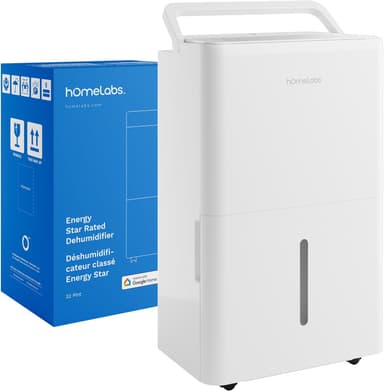
hOmeLabs
hOmeLabs 4,500 Sq Ft Dehumidifier
$249.99
Energy Star certified 50-pint dehumidifier for large spaces up to 4,500 sq ft. Continuous drain option, auto shutoff, digital controls.
- Energy Star certified
- Continuous drain option eliminates emptying
- Large capacity for basements
As an Amazon Associate we earn from qualifying purchases. Prices updated regularly.
The hOmeLabs 4,500 Sq Ft Energy Star Dehumidifier is our top pick for large basements and whole-home applications. It removes up to 50 pints per day, connects to a drain hose so you never have to empty the tank, and carries Energy Star certification for reasonable electricity bills. Its built-in pump (on pump-equipped models) can push water uphill to a sink or floor drain — especially useful in below-grade basements where gravity draining isn't an option.
Midea
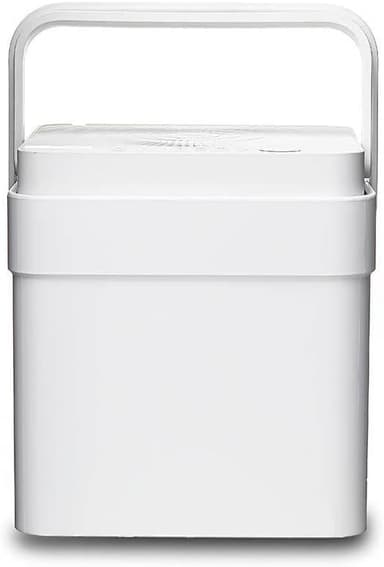
Midea Cube 50 Pint Smart Dehumidifier
$259.99
A revolutionary 50-pint dehumidifier with a patented lift-and-twist design providing 3× more water tank capacity. ENERGY STAR Most Efficient certified, Wi-Fi enabled, and independently ranked as one of the fastest dehumidifying units ever tested.
- Patented lift-and-twist design with 3× more tank capacity
- Ranked fastest extraction rate in independent testing
- ENERGY STAR Most Efficient certified
As an Amazon Associate we earn from qualifying purchases. Prices updated regularly.
If floor space is tight or you want a more modern design with app control, the Midea Cube 50-pint Smart Dehumidifier is an excellent alternative. Its collapsible tank design takes up significantly less floor footprint than traditional barrel-style units, and its Wi-Fi connectivity lets you monitor humidity and set targets from your phone. It also carries Energy Star certification and supports continuous drain via hose.
Frigidaire
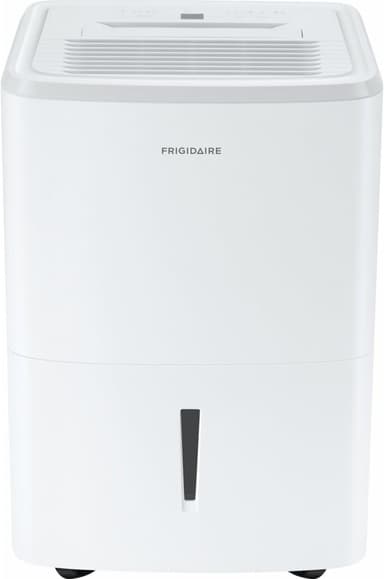
Frigidaire FFAD5033W1 Dehumidifier
$219.99
50-pint dehumidifier with Effortless™ humidity control. Quiet, reliable, and easy to use for medium to large rooms.
- Trusted Frigidaire brand reliability
- Quiet operation
- Simple, intuitive controls
As an Amazon Associate we earn from qualifying purchases. Prices updated regularly.
For smaller spaces — a single bedroom, a bathroom, or a modestly sized basement — the Frigidaire FFAD5033W1 is a reliable, no-frills 50-pint unit. It's quieter than many competitors at comparable fan speeds and has a straightforward control panel with a built-in humidistat, so it cycles on and off automatically to maintain your target humidity level without running continuously.
Signs You Need an Air Purifier
Air purifiers address a different category of problem: particles and gases that are already airborne and being breathed in. Humidity may be perfectly normal, but the air still carries irritants.
Situations where an air purifier helps most
- Allergies to dust, pollen, or pet dander — True HEPA filters capture these particles efficiently. If your allergy symptoms are worst indoors during certain seasons or in certain rooms, an air purifier positioned strategically can make a meaningful difference.
- Pets in the home — pet dander is among the most common indoor allergens and is small enough (2–10 microns) to remain airborne for hours. HEPA filtration is the most effective way to reduce circulating dander.
- Wildfire smoke or outdoor air quality events — smoke particles (PM2.5) are captured well by HEPA filters. During smoke events, closing windows and running a HEPA purifier is the standard recommended approach.
- Gas cooking or VOC sources — air purifiers with activated carbon layers help reduce volatile organic compounds from cooking, cleaning products, new furniture, and paints. (Ventilation to outdoors is still the priority for gases like NO2 and CO, but carbon filtration helps with lighter VOC loads.)
- Recent painting, renovation, or new furniture — off-gassing from paints, adhesives, composite wood products, and new carpet is a common source of elevated indoor VOC levels. A purifier with both HEPA and carbon filtration helps accelerate clearance.
- Children, elderly residents, or anyone with asthma or COPD — these groups are more sensitive to fine particulate exposure, making indoor particle control more impactful.
Air purifiers do not reduce humidity, prevent mold growth, or address the root cause of high particle counts if that root cause is a chronic source (an unaddressed mold colony, for instance, will keep shedding spores into the air faster than any purifier can remove them). For mold, you address the moisture problem first. For an overview of what poor air quality looks like, our guide on 5 signs your indoor air quality is affecting your health covers the broader picture.
Recommended air purifiers
Coway
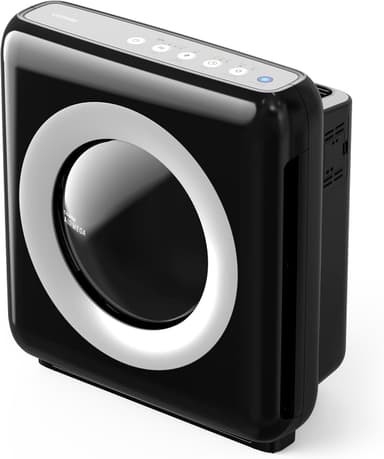
Coway AP-1512HH Mighty Air Purifier
$89.99
Best-selling 4-stage filtration air purifier for rooms up to 360 sq ft. True HEPA + activated carbon + ionizer.
- Exceptional value for HEPA filtration
- Auto mode with real air quality sensing
- Quiet operation (sleep mode)
As an Amazon Associate we earn from qualifying purchases. Prices updated regularly.
The Coway AP-1512HH Mighty is one of the most consistently recommended HEPA air purifiers in its class for a simple reason: it performs well above its price point. It includes a True HEPA filter, a pre-filter that's washable (reducing ongoing cost), and an activated carbon filter for odors. Its auto mode — which adjusts fan speed based on a real-time particle sensor — makes it set-and-forget for everyday use. Rated for rooms up to 360 sq ft (four air changes per hour), it's ideal for a bedroom or home office.
Levoit
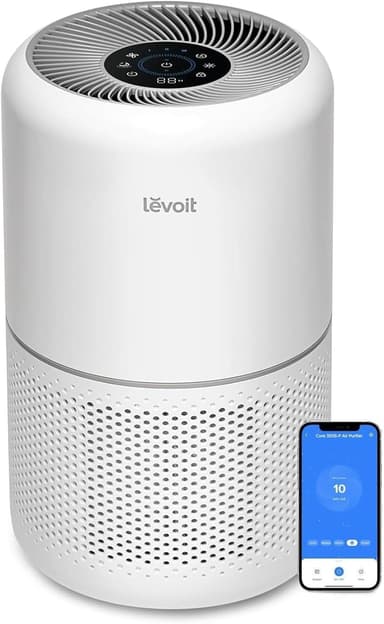
Levoit Core 300S Smart Air Purifier
$99.99
Amazon's #1 bestselling air purifier with over 100,000 five-star reviews. True H13 HEPA filters 99.97% of 0.3-micron particles for rooms up to 219 sq ft, with whisper-quiet sleep mode and VeSync app control.
- Amazon's #1 bestselling air purifier with 100K+ reviews
- True H13 HEPA removes 99.97% of 0.3-micron particles
- Whisper-quiet at 24 dB in sleep mode
As an Amazon Associate we earn from qualifying purchases. Prices updated regularly.
For smaller rooms or a first-time buyer who wants to test the impact of air purification before committing to a larger unit, the Levoit Core 300S is a strong entry point. Its compact cylindrical design blends into most interiors, its 360° air intake makes placement flexible, and the companion app offers scheduling and filter-replacement reminders. It handles rooms up to 219 sq ft at four air changes per hour. For larger spaces, step up to the Levoit Core 600S (featured in our best air purifiers for allergies guide), which covers rooms up to 1,588 sq ft.
For a deeper look at filter types, CADR ratings, and what marketing terms like "HEPA-type" actually mean, see our guide to choosing the right HEPA air purifier and our explainer on what HEPA actually means.
When You Need Both
There's a meaningful subset of home situations where both a dehumidifier and an air purifier are genuinely useful — but it's important to understand that they work on separate problems simultaneously, not redundantly.
Basement spaces
Basements are the most common "both needed" scenario. High humidity in a basement creates conditions for mold growth, which then releases spores into the air. A dehumidifier controls the humidity (addressing the root cause of mold). An air purifier with HEPA filtration captures any spores already circulating. Together they're more effective than either alone — but the dehumidifier is the priority because without moisture control, the mold source continues generating spores indefinitely regardless of how good your filter is.
Allergy sufferers in humid climates
If you live in a humid region (Southeast US, Gulf Coast, Pacific Northwest) and have allergies or asthma, high humidity sustains high dust mite populations and mold year-round. A dehumidifier keeps dust mites in check (they require relative humidity above 50% to reproduce) while an air purifier removes airborne mite allergen particles that are already in circulation. This combination makes a real difference for asthma sufferers during high-humidity months.
Post-water-damage remediation
After a flood, pipe leak, or other water intrusion event, you need aggressive dehumidification to dry out the space and prevent mold establishment (FEMA guidelines recommend getting a water-damaged space below 60% RH within 24–48 hours to prevent mold). An air purifier running simultaneously helps capture drywall dust, mold spores disturbed during remediation, and airborne debris from the cleanup process.
For more guidance on controlling humidity specifically, our homeowner's guide to mold prevention covers the full spectrum of humidity control strategies alongside ventilation and testing.
Frequently Asked Questions
Can a dehumidifier improve allergies?
Yes, indirectly — by keeping humidity below 50%, you inhibit dust mite reproduction (dust mites require relative humidity above 50% to survive and breed) and prevent mold growth, both of which are potent allergens. But a dehumidifier doesn't filter particles from the air. For direct particle removal, pair it with an air purifier. Many allergy sufferers in humid homes see the biggest improvement from running both.
Will an air purifier reduce humidity?
No. Air purifiers have no mechanism for removing moisture from the air. Some people assume that because an air purifier "cleans" the air, it also controls humidity — it doesn't. If your hygrometer reads above 55% or you have visible condensation, an air purifier will do nothing for that problem. Only a dehumidifier removes water vapor.
Does a dehumidifier help with mold smell?
Yes, over time. Musty odors are produced by mold metabolism — if you lower humidity enough that mold stops actively growing, the odor source diminishes. However, activated carbon in a good air purifier will also help adsorb the musty VOCs already circulating in the air, which can speed up the improvement in perceived air quality while your dehumidifier addresses the root cause. The dehumidifier is the cure; the air purifier treats the symptom.
How do I know what my indoor humidity is?
The easiest way is an inexpensive standalone hygrometer ($10–$20 at hardware stores or online), which displays current relative humidity in real time. Most mid-range and premium air quality monitors also include a humidity sensor — the Airthings View Plus and Amazon Smart Air Quality Monitor both do. If your reading is consistently above 55% in living areas or above 60% in basements, you have a humidity problem worth addressing.
Is it safe to run a dehumidifier and air purifier in the same room?
Completely safe and actually beneficial. They operate independently and don't interfere with each other. One common placement strategy is to run the dehumidifier in the corner or along a wall where moisture tends to be highest, and position the air purifier centrally in the room where it can draw air from all directions. Both can run continuously or on their respective auto/humidity-controlled modes without any conflict.
Which should I buy first if I can only afford one?
Diagnose your specific problem first. If you have high humidity (above 55%), visible condensation, musty smells, or visible mold, the dehumidifier is the higher priority — it addresses the root cause of the most serious home damage risk (mold, structural moisture, dust mite infestation). If your humidity is already in the normal 30–50% range and your main concern is allergies, smoke, dust, or chemical smells, start with the air purifier. When in doubt, a $15 hygrometer reading gives you the data to make the call.
The Bottom Line
Dehumidifiers and air purifiers are tools for two different jobs, and the key to choosing correctly is diagnosing your home's actual problem. If you're seeing condensation, smelling mustiness, or watching humidity readings above 55% on a monitor, the hOmeLabs 4,500 Sq Ft Dehumidifier or the smart-connected Midea Cube 50-pint will address the root cause that an air purifier simply can't touch. If your air is dry but dusty, smoky, or allergen-laden, the Coway AP-1512HH Mighty is among the best value HEPA purifiers on the market for a bedroom or office, with the compact Levoit Core 300S as an excellent smaller-room option.
For the significant number of homes — particularly basements, crawl spaces, and houses in humid climates — where both humidity and airborne particles are a concern, running both devices together makes sense. They complement each other cleanly: the dehumidifier removes the moisture that drives mold and dust mite growth; the air purifier catches the allergen particles those conditions produce. Tackle the humidity first, then layer in filtration for the airborne load. That sequence gets you the best results for the least total cost.