Indoor Air Quality for Renters: What You Can Actually Do Without a Landlord's Permission
You can't install a mitigation system or tear out moldy drywall in a rental — but renters have more options than they think. Here's a landlord-free plan for testing and improving the air in an apartment.

Affiliate Disclosure
HomeAirWise participates in the Amazon Associates program and other affiliate partnerships. When you click a product link and make a purchase, we may earn a small commission at no additional cost to you. This helps us maintain the site and continue providing independent research and recommendations. Read our full disclosure.
Most home air quality advice assumes you own the walls: seal the crawl space, install a sub-slab depressurization system, replace the HVAC filter with a MERV-13, re-caulk the windows. If you rent, that advice is mostly useless — you can't drill through a foundation you don't own, and even simple fixes can put your security deposit at risk if you're not careful about what counts as a "modification."
But renters aren't actually powerless here. The tools that matter most for indoor air quality — testing, portable filtration, humidity control, and ventilation habits — don't require owning the building. This guide walks through what you can test, what you can fix yourself, what you should document and hand to your landlord in writing, and which products are actually designed to work in a space you don't own.
Why Renters Face a Different Set of Problems
Rental units have air quality risk factors that owner-occupied homes often don't, simply because of how they're built, maintained, and turned over between tenants:
- Deferred maintenance. HVAC filters in rental units are frequently the cheapest fiberglass option available and go unchanged for months between tenants. Central air handlers you don't have access to can recirculate dust, pet dander from a previous tenant, and mold spores from an unnoticed leak.
- Ground-floor and below-grade units carry elevated radon risk. Radon gas seeps up from soil and concentrates in the lowest occupied level of a building. If you're in a garden-level, basement, or first-floor apartment, your radon exposure can be just as high as a single-family home's — the EPA's national testing recommendation applies to rentals exactly as it does to houses, but very few landlords test proactively. See our primer on why the EPA recommends every home be tested for radon for the full health rationale.
- Turnover conceals prior water damage. A fresh coat of paint is an extremely effective way to hide a mold problem for a showing. Cosmetic fixes between tenants sometimes paper over — literally — a leak that was never properly dried out and repaired.
- You often can't control shared systems. In multi-unit buildings, a neighbor's smoking, a shared HVAC trunk line, or a poorly ventilated shared laundry room can affect your air without your having any way to intervene at the source.
- Lease terms restrict physical changes. Sealing gaps with expanding foam, running exhaust ducting through a wall, or installing a permanent radon mitigation fan are all off the table without landlord approval, and many leases treat unauthorized modifications as a deposit deduction — or a lease violation.
None of this means you're stuck breathing whatever air your unit gives you. It means the strategy looks different: test first, use portable and reversible fixes, and know when a problem crosses the line into something your landlord is legally obligated to address.
Step One: Test Before You Assume
Every fix on this list costs money and effort, so start by figuring out what you're actually dealing with rather than guessing. All of the following are renter-friendly — no installation, no permanent alteration, and most fit in a drawer when you're done.
Radon: a $15–$30 test kit, no landlord needed
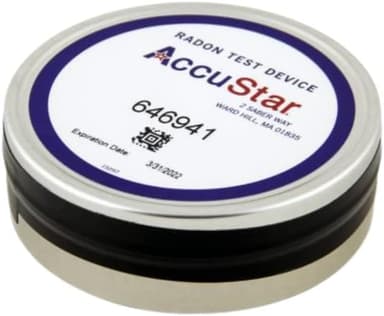
Short-term charcoal radon test kits are inexpensive, require no setup beyond placing them in your lowest lived-in room for 2–7 days, and get mailed to a lab for results. The EPA's action level is 4 pCi/L — if your result comes back at or above that, it's worth a conversation with your landlord and, if you're in a ground-floor or basement unit, a second confirmatory test. Nothing about placing a passive test canister on a shelf requires anyone's permission.
AccuStar Labs
AccuStar Charcoal Short-Term Radon Test Kit
$14.99
The most widely used EPA-recognized short-term radon test in the US, trusted by home inspectors and real estate professionals. Activated charcoal canister delivers accurate 48–96 hour results with certified lab analysis included.
- Most trusted lab brand for real estate radon testing
- EPA-recognized and NRPP-certified methodology
- Prepaid lab return envelope included — no extra fees
As an Amazon Associate we earn from qualifying purchases. Prices updated regularly.
The AccuStar Charcoal Short-Term Radon Test Kit is about as low-friction as testing gets: open it, set it on a shelf in your lowest occupied room, seal it up after the exposure period, and mail it in. There's nothing to install and nothing your landlord needs to sign off on.
Mold: a swab or air-sampling kit for under $30
If you notice a musty smell, water stains, or discoloration around windows, bathroom tile, or HVAC vents, a DIY mold test kit can tell you whether you're dealing with a surface issue or something growing behind a wall. These kits won't identify the exact species (that requires professional lab analysis), but they will confirm whether elevated mold is present, which is the evidence you need before asking your landlord to investigate further. Our guide to the best mold test kits breaks down swab versus air-sampling versus petri dish options and when each makes sense.
General air quality: a plug-in monitor
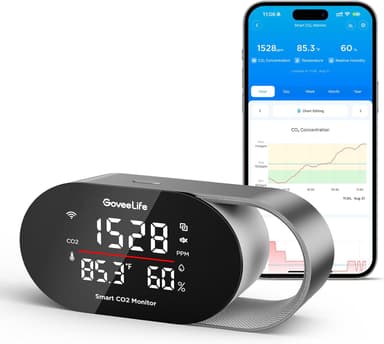
A portable air quality monitor — no wiring, just plug it in or run it on battery — gives you continuous readings on PM2.5, humidity, VOCs, and sometimes CO2. This is the single most useful renter tool on this list because it turns "I feel like the air in here is bad" into a documented, timestamped data trail. If you ever need to make a habitability complaint, "the app logged 65% relative humidity for three straight weeks" is a much stronger case than a verbal description.
Govee
Govee Air Quality Monitor
$49.99
Budget-friendly indoor air quality monitor tracking PM2.5, CO2, TVOC, temperature, and humidity with a large color display.
- Very affordable for multi-sensor monitoring
- Large, clear color display
- Bluetooth app with historical data
As an Amazon Associate we earn from qualifying purchases. Prices updated regularly.
The Govee Air Quality Monitor is a good starting point for renters specifically because it's cheap enough to not think twice about, requires no installation, and logs humidity and PM2.5 trends over time in its companion app — exactly the kind of record that's useful if a dispute with a landlord ever needs documentation. For a full inventory of monitor options across price points, see our complete guide to testing your home's air quality.
Step Two: Filtration You Can Take With You
The biggest advantage a renter has over relying on a building's shared HVAC system is that a portable HEPA air purifier is completely independent of it — no ductwork, no filter access, no coordination with a landlord or property manager required. Plug it in, and it filters the air in that room regardless of what the central system is or isn't doing.
Levoit
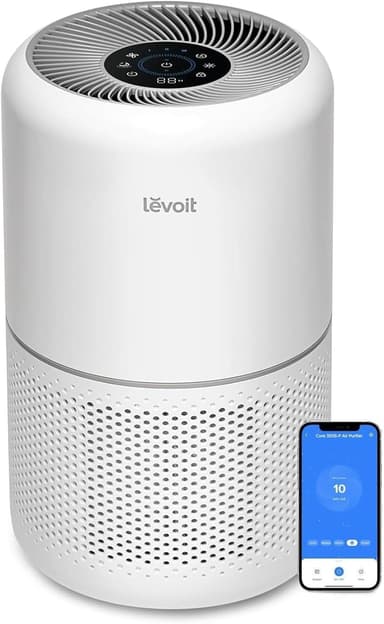
Levoit Core 300S Smart Air Purifier
$99.99
Amazon's #1 bestselling air purifier with over 100,000 five-star reviews. True H13 HEPA filters 99.97% of 0.3-micron particles for rooms up to 219 sq ft, with whisper-quiet sleep mode and VeSync app control.
- Amazon's #1 bestselling air purifier with 100K+ reviews
- True H13 HEPA removes 99.97% of 0.3-micron particles
- Whisper-quiet at 24 dB in sleep mode
As an Amazon Associate we earn from qualifying purchases. Prices updated regularly.
The Levoit Core 300S is particularly well-suited to renters: it's compact enough for a nightstand or corner shelf, requires no mounting or hardwiring, and — critically — it's an asset you keep. Unlike a mitigation system or duct sealing, every dollar you spend on a portable purifier is something you take with you to the next apartment. It covers rooms up to roughly 219 sq ft at a healthy air-change rate, which fits most rental bedrooms and studio layouts. For guidance on sizing a purifier to a larger living room or open-concept unit, see our guide to choosing the right HEPA air purifier.
If you do have access to a central HVAC filter slot
Some rentals — particularly single-family homes and townhomes managed by smaller landlords — do give tenants access to a return-air filter slot for the furnace or air handler. If that's your situation, swapping the cheapest fiberglass filter for a pleated MERV-11–13 filter is a low-cost, fully reversible upgrade (keep the old filter to reinstall at move-out if your lease requires restoring original condition). This is different from HVAC repairs or duct sealing — it's routine filter maintenance that most leases don't restrict, but check your lease language or ask before assuming.
Step Three: Humidity and Mold Prevention You Control
Mold needs sustained moisture to establish, and a surprising amount of humidity control in a rental comes down to habits rather than equipment:
- Run the bathroom exhaust fan during and for 20–30 minutes after every shower. If your bathroom doesn't have a working exhaust fan, that's a maintenance request worth submitting in writing — most local housing codes require functioning bathroom ventilation.
- Use the kitchen range hood when cooking, especially with gas burners, to clear both moisture and combustion byproducts.
- Keep a portable dehumidifier in problem rooms. Basement apartments, garden-level units, and rooms with poor cross-ventilation often run persistently above the EPA's recommended 30–50% relative humidity range. A compact, tank-based dehumidifier requires no installation and, like a purifier, is an asset you keep.
- Wipe down condensation on windows and sills promptly rather than letting it sit — this is one of the most common, and most preventable, sources of window-frame mold in older rental buildings with single-pane glass.
- Report leaks immediately and in writing. A pipe leak or roof intrusion that gets dried out within 24–48 hours rarely develops into a mold problem. One that sits unreported for a week almost always does. Text or email your landlord the moment you notice water intrusion — this creates a timestamp that matters if mold develops later and responsibility is disputed.
For the full mechanics of how humidity drives mold growth and the numbers to watch for, our homeowner's guide to mold prevention applies just as directly to a rental — the humidity thresholds don't change based on who owns the building.
Healthful Home
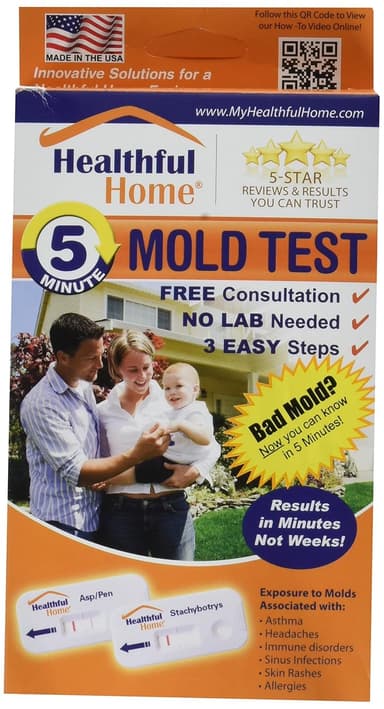
Healthful Home 5-Minute Mold Test
$29.99
Quick at-home mold screening test with results in 5 minutes. No lab required. Detects common mold types.
- Results in 5 minutes (no lab wait)
- Easy to interpret results
- Good for spot-checking specific surfaces
As an Amazon Associate we earn from qualifying purchases. Prices updated regularly.
If you spot discoloration behind furniture, under a window, or around a vent and want a quick answer before deciding whether to escalate, the Healthful Home 5-Minute Mold Test gives you a same-day result from a simple surface swab. It won't tell you the mold species, but it will tell you whether what you're looking at is actually mold — useful information before you request a professional inspection or file a habitability complaint.
Step Four: What Crosses the Line Into "Landlord's Problem"
Most U.S. states recognize an implied warranty of habitability — a legal principle that a rental must be safe and livable regardless of what the lease does or doesn't say. Exact standards and enforcement mechanisms vary significantly by state and city, so this isn't legal advice, but as a general framework, the following typically fall on the landlord's side of the line, not yours:
| Issue | Usually your responsibility | Usually the landlord's responsibility |
|---|---|---|
| Mold from a structural leak (roof, plumbing, foundation) | Reporting it promptly, keeping the area ventilated | Repairing the leak source, remediating existing mold |
| Mold from your own condensation/humidity habits | Ventilating, using a dehumidifier, wiping condensation | Providing working exhaust fans and windows that open |
| Elevated radon reading | Testing, reporting results in writing | Mitigation system installation (required in some states/cities upon disclosure) |
| Broken or missing bathroom/kitchen exhaust fan | Reporting the issue | Repair or replacement — often a code requirement |
| Dirty central HVAC filter you have no access to | Requesting service | Filter changes on any system tenants can't access themselves |
| Dust, odors, or allergens from your own belongings/pets | Portable filtration, cleaning | Not applicable |
| Pest infestation contributing to allergens | Reporting promptly, reasonable sanitation | Pest control — a standard habitability item in most jurisdictions |
The practical playbook when you find something that belongs on the landlord's side: document it (photos, test results, dated notes), submit the request in writing (email creates a paper trail; a phone call doesn't), keep a copy, and follow your local jurisdiction's process if it isn't addressed in a reasonable time frame. Many cities have a tenant rights hotline or housing department that can explain the specific timeline landlords are required to meet — this varies enough by state that it's worth a quick search for your specific city or county housing authority rather than relying on general advice.
Step Five: Reversible Upgrades That Won't Cost You Your Deposit
A few additional fixes sit in a gray zone — not required of your landlord, but easy for you to do without violating a typical lease:
- Door draft stoppers at the bottom of exterior doors reduce both drafts and the entry point for outdoor pollutants and pests — no tools, no residue.
- Removable weatherstripping (the peel-and-stick foam kind, not expanding foam) can reduce drafts around old windows without any permanent alteration, and it peels off cleanly at move-out.
- Command-strip-mounted monitors and small purifiers let you keep devices off counters and out of the way without drilling.
- Washable pre-filters on your portable purifier extend the life of the HEPA filter and reduce how often you need to buy replacements — a genuine cost saver over a multi-year lease.
What to avoid regardless of how tempting it is: caulking around windows or baseboards you don't own, running duct tape or foam into wall cavities to "test" for drafts, or attempting any radon mitigation fan installation yourself. These cross from reversible into modification territory, and in the case of radon mitigation, improperly installed systems can actually depressurize a space incorrectly and make the problem worse.
Frequently Asked Questions
Can my landlord refuse to let me test for radon or mold?
No — testing your own living space with a passive test kit (radon canister, mold swab) doesn't require landlord permission because it doesn't alter the property in any way. You're free to test at any time. What requires landlord involvement is remediation: installing a mitigation system, opening a wall to address a mold source, or any structural repair.
Is my landlord legally required to test for radon before I move in?
It depends entirely on your state and city — radon disclosure requirements for landlords vary widely, and many jurisdictions have no requirement at all. A growing number of states require disclosure of known radon test results at the time of a lease, but proactive testing obligations are far less common. The safest assumption is that no one has tested unless you can see a report, which is exactly why testing it yourself for $15–$30 is worth doing regardless of what's legally required.
Will a portable air purifier actually help if my whole building has poor ventilation?
Yes, within the room it's operating in. A portable purifier can't fix building-wide ventilation problems, but it directly filters the air you're actually breathing in your bedroom or living room, independent of what's happening in the hallway or a neighboring unit. It's a real, measurable improvement to your immediate air — just not a substitute for building-level ventilation fixes that are outside your control.
What if my lease says I can't have any appliances plugged in overnight?
This is uncommon but does appear in some leases, typically framed around fire safety concerns rather than air quality specifically. Read your lease's appliance and alteration clauses carefully; portable air purifiers, dehumidifiers, and air quality monitors are standard UL-listed consumer electronics and are very rarely restricted, but if you're unsure, a quick written question to your property manager avoids any ambiguity later.
Should I bring my portable purifier and monitor when I move?
Yes — this is one of the clearest financial advantages of renter-friendly, portable solutions over built-in fixes. A HEPA purifier, a dehumidifier, and an air quality monitor are all assets that move with you and keep working in your next apartment, unlike a security deposit spent on a fix that becomes the next tenant's benefit, not yours.
How do I know if a musty smell is actually mold or just an old-building smell?
A persistent musty odor that doesn't dissipate with ventilation is worth investigating with a test kit rather than assuming — mold produces distinctive microbial VOCs that account for that smell in the majority of cases where it's present. If a swab or air-sampling test comes back elevated, or you can see visible discoloration anywhere near the source of the smell, treat it as confirmed mold and start the documentation process with your landlord.
The Bottom Line
Renting doesn't mean accepting whatever air quality you're handed — it means shifting your toolkit from permanent fixes to portable, testable, and documented ones. Start with a radon test kit and a mold swab to establish facts rather than assumptions, add a plug-in monitor like the Govee Air Quality Monitor to build a data trail over time, and run a portable purifier like the Levoit Core 300S in whichever room you spend the most time in. If a test or monitor turns up something that points to a structural issue — a leak, inadequate ventilation, or an elevated radon reading — document it in writing and put it on your landlord's side of the ledger, where it belongs.
The through-line across every recommendation here is that nothing requires permission and nothing gets left behind at move-out. That's the renter's real advantage: every dollar spent on testing and portable filtration is a dollar that keeps paying off in the next apartment, too.