Best Mold Test Kits in 2026: How to Find Out If You Really Have a Problem
A musty smell or a dark spot on the ceiling doesn't tell you what kind of mold you're dealing with — or whether it's even mold at all. Here's how to choose the right test kit and read the results correctly.

Affiliate Disclosure
HomeAirWise participates in the Amazon Associates program and other affiliate partnerships. When you click a product link and make a purchase, we may earn a small commission at no additional cost to you. This helps us maintain the site and continue providing independent research and recommendations. Read our full disclosure.
Every home has mold spores in it. They're in outdoor air, they ride in on shoes and pets, and they're a normal part of the environment. The question that actually matters isn't "do I have mold spores in my house" — the answer is always yes — it's whether you have an active growth problem, what species is involved, and how urgently it needs to be addressed.
That's where a mold test kit comes in. But not all kits answer the same question. Some give you a "yes/no" in five minutes. Others ship a sample to an accredited lab and come back with a species-level identification and spore count. Picking the wrong one for your situation means either overpaying for data you don't need, or — worse — getting a vague "mold detected" result that doesn't tell you whether you're looking at a minor cosmetic issue or something that needs professional remediation.
We compared the most widely used consumer mold test kits on accuracy, turnaround time, and what they actually tell you. Here's how to pick the right one — and how to interpret what comes back.
What a Mold Test Kit Can (and Can't) Tell You
Before buying anything, it helps to understand the three broad categories of mold testing available to homeowners:
| Test Type | How It Works | What You Learn | Turnaround |
|---|---|---|---|
| Rapid screening test | Surface swab + lateral flow strip (like a home pregnancy test) | Mold allergens present or not present | ~5 minutes |
| Air sampling + lab analysis | Settling plate or cassette collects airborne spores, mailed to a lab | Species identification, spore concentration, indoor vs. outdoor comparison | 3–5 business days |
| Surface swab + lab analysis | Swab collects spores from a visible growth, mailed to a lab | Species identification (genus-level) | 3–5 business days |
Notice what's missing from all three: none of them tell you how much mold is hidden behind your walls or how big the remediation job will be. Test kits are a screening and identification tool, not a substitute for a professional inspection if you already have visible, extensive growth (the EPA generally considers anything larger than about 10 square feet — roughly a 3-by-3-foot patch — a job for a professional remediation contractor, regardless of what species it turns out to be).
Where test kits genuinely earn their keep is in the gray areas: a musty smell with no visible source, a small stain you're not sure is mold, post-remediation verification, or due diligence before buying a home. Our guide to mold prevention, humidity, and testing covers how these pieces fit together as part of an overall strategy.
Our Top Mold Test Kit Picks for 2026
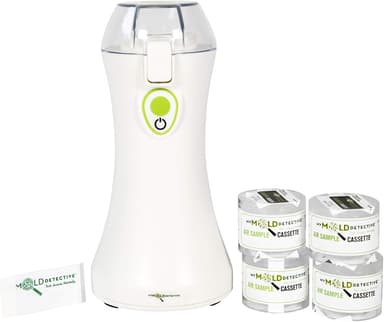
My Mold Detective
My Mold Detective MMD103
$39.99
5-test mold detection kit with air and surface sampling. AIHA-accredited lab analysis included.
- Includes both air and surface sampling
- AIHA-accredited lab analysis
- 5 tests in one kit
As an Amazon Associate we earn from qualifying purchases. Prices updated regularly.
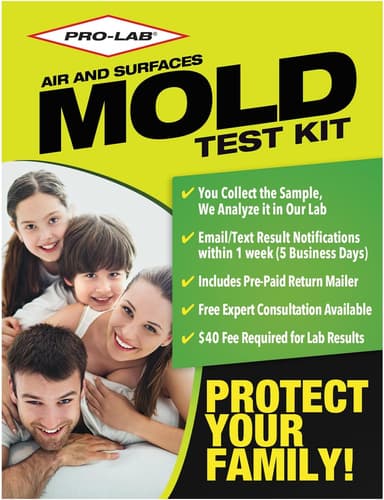
PRO-LAB
PRO-LAB MO109 Professional Mold Test Kit
$9.99
The most affordable professional mold test kit for homeowners, using four sampling methods including air sampling and surface swabs. AIHA-certified lab identifies specific mold species — results in under 5 days.
- Most affordable entry point for certified lab mold testing
- AIHA-certified laboratory analysis
- Identifies specific mold species (genus-level)
As an Amazon Associate we earn from qualifying purchases. Prices updated regularly.
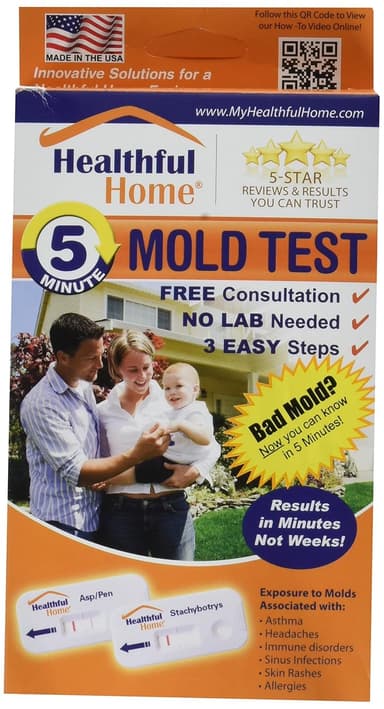
Healthful Home
Healthful Home 5-Minute Mold Test
$29.99
Quick at-home mold screening test with results in 5 minutes. No lab required. Detects common mold types.
- Results in 5 minutes (no lab wait)
- Easy to interpret results
- Good for spot-checking specific surfaces
As an Amazon Associate we earn from qualifying purchases. Prices updated regularly.
How to Choose Between a Rapid Test and a Lab-Analyzed Test
When a 5-Minute Rapid Test Is Enough
If you've spotted a discolored patch on a bathroom ceiling, behind the washing machine, or under a sink, and you just want to know whether it's mold before you grab a paper towel and bleach, a rapid lateral-flow test like the Healthful Home 5-Minute Mold Test is the right tool. It detects mold allergen proteins directly from a surface swab and gives you a binary answer using the same two-line/one-line convention as a home pregnancy or COVID test.
The catch: a positive result doesn't tell you which species you're dealing with, and a negative result on one specific spot doesn't rule out mold elsewhere — including inside walls or above ceiling tiles where you can't swab directly. Rapid tests are best used as a quick first pass or to confirm that a remediated area is clean afterward.
When You Need Lab Analysis
If any of the following apply, skip the rapid test and go straight to a lab-analyzed kit:
- You smell mold but can't see it. Air sampling can detect elevated airborne spore counts even when there's no visible growth — often a sign of mold growing inside walls, under flooring, or in HVAC ductwork.
- Someone in the household has respiratory symptoms. Knowing the specific species matters here. Stachybotrys chartarum ("black mold") and certain Aspergillus and Penicillium species are associated with more significant health effects than common, largely benign molds like Cladosporium, which is found in nearly every home and outdoor environment.
- You're buying or selling a home. A lab report with species identification and an indoor-vs-outdoor comparison is far more credible in negotiations than "the inspector said it smelled musty."
- You've completed remediation and want to verify the work. A post-remediation air sample compared against an outdoor baseline sample is the standard way professionals confirm a space is clear.
Both the My Mold Detective MMD103 and the PRO-LAB MO109 use AIHA-accredited (American Industrial Hygiene Association) laboratories — one of the more rigorous independent certifications in environmental testing. The MO109 is the more budget-friendly entry point at under $10 for the kit itself (plus a separate lab fee), while the My Mold Detective kit bundles five tests with the lab analysis included, which works out to better value if you're sampling multiple rooms.
How to Get an Accurate Sample
Mold test results are only as good as the sample collection technique. A few mistakes account for most unreliable results:
Always Take an Outdoor Baseline Sample
This is the single most important step in air sampling, and it's the one most homeowners skip. Outdoor air always contains mold spores — that's normal and expected. The lab compares your indoor sample against the outdoor baseline. If your indoor spore count and species mix roughly matches the outdoor sample, that's a good sign: your indoor air isn't harboring an active growth source. If your indoor sample shows species that aren't present outdoors, or concentrations significantly higher than outdoors, that points to an indoor source. Without the baseline, an indoor reading is essentially meaningless — you have nothing to compare it to.
Test Multiple Locations
If you suspect a problem in a specific room (say, a basement with a musty smell), test that room, plus at least one "control" room elsewhere in the house with no suspected issues, plus your outdoor baseline. This three-point comparison — suspect area, control area, outdoor — is how professionals interpret results and is the approach built into kits like the My Mold Detective, which includes enough tests for exactly this kind of comparison.
Don't Test Right After Cleaning or Disturbing the Area
Vacuuming, dusting, or scrubbing a moldy surface right before testing can either artificially elevate airborne spore counts (by disturbing settled spores into the air) or artificially reduce them (by removing the surface growth being sampled). Wait at least 24 hours after any cleaning activity, and avoid running fans, air purifiers, or HVAC systems during the sampling period itself, since this can dilute or skew air sample results.
Follow the Timing Instructions Exactly
Air sampling cassettes and settling plates are calibrated for specific exposure times — typically 1 hour for settling plates, or a specified number of liters of air pumped through a cassette. Leaving a sample open too long oversaturates it and makes lab analysis difficult; too short and spore counts may be too low to be statistically meaningful.
Understanding Your Lab Report
When your results come back, you'll typically see a table listing mold genera (Cladosporium, Aspergillus/Penicillium, Stachybotrys, Alternaria, etc.) with spore counts for each sample location, side by side with your outdoor baseline. A few things to know when reading this:
- Cladosporium and Alternaria are extremely common outdoors and in homes with no problem at all — seeing them indoors at levels similar to outdoors is normal.
- Aspergillus/Penicillium (often reported together because they look similar under a microscope) are common indoor molds. Elevated levels relative to outdoors can indicate damp conditions — carpets, wallpaper, or HVAC systems are common sources.
- Stachybotrys is less common and almost always indicates a chronic moisture problem — it requires consistently wet conditions (often from a slow leak) to grow. Any detection of Stachybotrys indoors, even at low levels, generally warrants finding and fixing the moisture source.
- There is currently no federal standard for "safe" indoor mold spore levels — the EPA has not established numeric limits, in part because sensitivity varies enormously between individuals. Lab reports typically provide context (e.g., "this level is consistent with normal background" or "this level suggests an indoor source") rather than a pass/fail grade.
If your results point to elevated mold linked to humidity, the fix usually starts with moisture control — see our guides on reducing indoor humidity to prevent mold and our roundup of the best dehumidifiers for basements and homes.
Mold Testing vs. Just Calling a Professional
For visible mold covering more than about 10 square feet, or mold resulting from significant water damage (a burst pipe, flooding, a major roof leak), the EPA's general guidance is to skip DIY testing and bring in a professional remediation contractor — at that scale, the question isn't "is this mold" (it almost certainly is) but "how do we safely remove it without spreading spores throughout the house." Professional remediation typically runs $1,500–$10,000+ depending on the affected area and whether structural materials need replacement.
For everything smaller than that — a stain you're unsure about, a musty smell with no visible source, post-remediation verification, or pre-purchase due diligence — a test kit is the right first step, and can save you from paying for a professional inspection you might not need, or conversely, give you the documentation to justify one.
Frequently Asked Questions
Can a mold test kit detect mold inside walls?
Air sampling kits can detect elevated airborne spore counts that may indicate mold growing inside walls, even when nothing is visible — spores migrate through small gaps, electrical outlets, and HVAC penetrations. However, no consumer test kit can directly sample inside a wall cavity without cutting an access hole, which is typically a job for a professional with a borescope and moisture meter.
How much does professional mold testing cost compared to a DIY kit?
DIY kits with lab analysis typically cost $10–$50 for the kit plus a $30–$50 lab fee per sample, so a multi-sample test runs roughly $50–$150 total. A professional mold inspector typically charges $300–$800 for a visit that includes air sampling, moisture meter readings, and a written report — useful if you need third-party documentation for a real estate transaction or insurance claim.
Is it normal for a mold test to come back positive?
Yes — in the sense that virtually every home will show some mold spores in an air sample, because they're ubiquitous in outdoor air and tracked in constantly. A "positive" result only becomes meaningful when compared against an outdoor baseline and when looking at which species are present. This is why outdoor baseline sampling is so important, and why rapid screening tests (which give a simple positive/negative without species or comparison data) should be interpreted cautiously.
How long does mold take to grow after water damage?
Under favorable conditions — warm temperatures and a damp surface — mold can begin growing within 24 to 48 hours of water exposure. This is why the standard advice after any leak or flooding is to dry affected materials within 24–48 hours wherever possible, and why testing is often recommended a week or more after water damage to allow time for any growth to become detectable.
Should I test for mold before buying a home?
It's a reasonable precaution, especially for homes with basements, crawl spaces, or a history of water damage. A simple air sampling test in the basement and main living areas, compared against an outdoor baseline, can reveal issues that a visual inspection misses — particularly in homes that have been recently painted or had cosmetic work done that could mask water stains. For a broader pre-purchase checklist, see our guide on radon testing before buying a house, since the same general due-diligence approach applies to both radon and mold.
Can I just use bleach without testing first?
For small areas of visible mold on non-porous surfaces (tile, glass, sealed countertops), cleaning with soap and water or a mild bleach solution is generally fine without testing first — you can see the mold, you're cleaning it, done. Testing becomes valuable when you can't see the mold (a smell with no visible source), when the affected material is porous (drywall, carpet, insulation — bleach doesn't penetrate these and the mold often regrows), or when you need documentation of the species and severity for health, insurance, or real estate purposes.
Bottom Line
For most homeowners dealing with a musty smell, unexplained allergy symptoms, or general due diligence, the My Mold Detective MMD103 is our top pick — its combination of air and surface sampling across five tests, with AIHA-accredited species identification included, gives you the most complete picture for the money. If budget is the priority and you mainly need a certified lab to confirm what's growing on a visible patch, the PRO-LAB MO109 delivers professional-grade identification at one of the lowest price points available. And if you just need a fast yes/no on a specific suspicious spot before deciding whether further testing is worthwhile, the Healthful Home 5-Minute Mold Test gets you an answer before you've finished making coffee.
Whichever kit you choose, remember the golden rule of mold testing: always include an outdoor baseline sample. Without it, even a perfect lab report can't tell you whether what's in your air is normal background or a sign of a problem that needs fixing. Our guide to signs your indoor air quality may be affecting your health and our complete beginner's guide to home air quality testing are good next stops if mold turns out to be one piece of a larger air quality picture.
Have questions about interpreting your results or choosing the right kit for your situation? Reach out to our editorial team — we're happy to help. You can also browse our full mold test kit reviews for detailed specs and side-by-side comparisons.