Cooking and Indoor Air Pollution: What Your Stove Releases Into Your Kitchen (and How to Clear It)
That sizzling pan does more than make dinner — it can spike pollutant levels in your kitchen well above outdoor limits. Here's what cooking actually puts into your air, and how to get it back out.

Affiliate Disclosure
HomeAirWise participates in the Amazon Associates program and other affiliate partnerships. When you click a product link and make a purchase, we may earn a small commission at no additional cost to you. This helps us maintain the site and continue providing independent research and recommendations. Read our full disclosure.
Most people think of air pollution as something that happens outside — traffic exhaust, wildfire smoke, factory emissions. But for many households, the single biggest pollution event of the day happens at dinnertime, in the kitchen, and it's largely invisible.
Cooking — especially frying, searing, broiling, and stir-frying on a gas burner — releases a mix of fine particulate matter (PM2.5), nitrogen dioxide (NO2), carbon monoxide (CO), and volatile organic compounds (VOCs) directly into the air you breathe. A widely cited 2022 Stanford study published in Science Advances found that a single gas burner left on for just a few minutes in a typical home kitchen can push NO2 concentrations above the EPA's outdoor 1-hour limit of 100 ppb — and in smaller kitchens without ventilation, those levels can persist and migrate into bedrooms within about an hour.
This doesn't mean you need to stop cooking, or panic about your stove. It means cooking pollution is a manageable, well-understood problem — one that the right combination of ventilation, monitoring, and air purification can largely solve. This guide breaks down exactly what's happening in your kitchen when you cook, the numbers that matter, and the practical steps that make the biggest difference.
What's Actually in Cooking Exhaust?
The pollutant mix depends heavily on your fuel source and cooking method, but the major categories are:
- Nitrogen dioxide (NO2) — Produced by combustion in gas and propane stoves. NO2 is a respiratory irritant linked to increased asthma risk, and the WHO's 2021 air quality guidelines set a 1-hour average limit of 200 µg/m³ (about 106 ppb) for outdoor air. Indoor kitchen readings during cooking routinely exceed this.
- Fine particulate matter (PM2.5) — Tiny particles from oil smoke, charring, and combustion byproducts. The WHO's updated guideline recommends a 24-hour average of no more than 15 µg/m³. Pan-frying or wok cooking can push a kitchen's PM2.5 into the hundreds of µg/m³ for the duration of cooking — short spikes that are still associated with measurable health effects when they happen daily.
- Carbon monoxide (CO) — A byproduct of incomplete combustion, most relevant with gas stoves and especially with malfunctioning burners or blocked venting.
- Acrolein and aldehydes — Released when oils are heated past their smoke point, particularly with high-heat methods like searing, deep-frying, and stir-frying. These compounds are eye and respiratory irritants and contribute to that lingering "fried food" smell.
- Ultrafine particles (UFPs) — Particles smaller than 0.1 microns, produced by high-heat searing and broiling. These are small enough to penetrate deep into lung tissue and aren't captured by standard PM2.5 sensors, which is why range hood ventilation matters even when your air quality monitor "looks fine."
Electric and induction stoves eliminate the combustion byproducts (NO2, CO) entirely, but cooking itself — the oil, the heat, the food — still generates PM2.5, ultrafine particles, and aldehydes regardless of what's underneath the pan. VOCs from cooking are a meaningful contributor to overall indoor chemical exposure, alongside cleaning products and new furnishings.
How Much Does Cooking Actually Raise Indoor Pollution?
To put real numbers on this, here's roughly what research and field measurements have found for common cooking activities in an average kitchen without range hood ventilation:
| Activity | Primary Pollutants | Typical Peak Increase | How Long Elevated |
|---|---|---|---|
| Boiling water / simmering | Humidity, minor PM2.5 | Low | Duration of cooking |
| Pan-frying or sautéing | PM2.5, aldehydes, VOCs | 50–200+ µg/m³ PM2.5 | 30–60+ minutes |
| Gas burner use (any) | NO2, CO | Often exceeds 100 ppb NO2 | 20–60+ minutes |
| Stir-frying / wok cooking | PM2.5, ultrafine particles | Can exceed 500 µg/m³ PM2.5 | 30–90 minutes |
| Oven broiling / searing | Ultrafine particles, smoke | High UFP spikes | Duration + 30 min after |
| Toasting / baking | Minor PM2.5 | Low to moderate | 10–20 minutes |
The takeaway isn't that any single meal is dangerous — it's that these spikes happen one to three times a day, every day, for years, in the room where families often spend the most waking time together. That cumulative exposure is what researchers are increasingly focused on, particularly for children and people with asthma or COPD.
Step 1: Use Your Range Hood — Every Time
This is the single most effective intervention, and it's also the most underused. Studies consistently find that range hoods are used for only a fraction of cooking events in most households, often because they're noisy, the homeowner doesn't realize how effective they are, or the hood vents indoors via a recirculating filter rather than outside.
What makes a range hood effective
- Vents to the outside, not back into the kitchen through a charcoal filter (recirculating hoods do little for gases like NO2 and only modestly reduce particles).
- Covers the back burners, not just the front — back-burner cooking is where ventilation effectiveness drops off most.
- Runs on high for high-heat cooking (frying, searing, wok cooking) and continues for 5–10 minutes after you finish, since pollutants linger.
- Has adequate CFM (cubic feet per minute) for your stove's BTU output — a common rule of thumb is at least 100 CFM per 10,000 BTUs of cooktop power.
If you have a microwave-mounted "hood" that just recirculates air through a charcoal filter, treat it as a last resort, not a real ventilation solution. Opening a kitchen window — even a few inches, ideally one near the stove with another window cracked elsewhere to create cross-flow — meaningfully helps when a vented hood isn't an option.
Step 2: Know What's in Your Air With a Monitor
You can't manage what you can't measure, and cooking pollution is a perfect example of "out of sight, out of mind." A real-time air quality monitor placed in or near the kitchen lets you see exactly how your cooking habits, ventilation, and stove type affect your air — and confirms whether your interventions are actually working.
Airthings
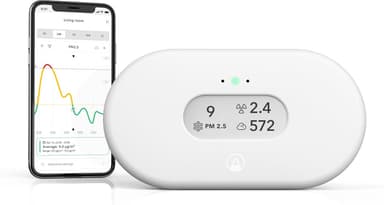
Airthings View Plus
$299.99
The most comprehensive home air quality monitor available. Tracks radon, PM2.5, CO2, VOCs, humidity, temperature, pressure, and more.
- 7 sensors including radon AND PM2.5 (rare combination)
- Built-in e-ink color display
- Wi-Fi with real-time app access
As an Amazon Associate we earn from qualifying purchases. Prices updated regularly.
The Airthings View Plus tracks PM2.5, VOCs, CO2, humidity, and temperature with a clean e-ink display and companion app — letting you watch pollution spikes happen in real time when you start cooking, and see how quickly they fall once you turn on your range hood or open a window. Many users are surprised the first time they watch a stir-fry push their PM2.5 reading from "good" to "unhealthy" within minutes — and just as surprised at how fast a vented hood brings it back down.
If you want a budget option to start with, a simpler PM2.5/VOC monitor placed on a counter near (but not directly over) the stove will still give you the core feedback loop you need.
Govee
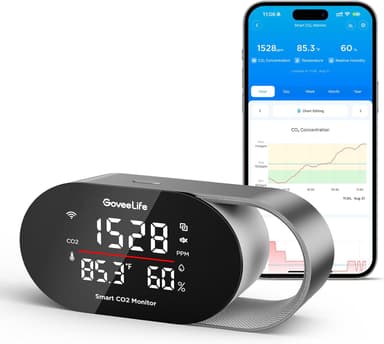
Govee Air Quality Monitor
$49.99
Budget-friendly indoor air quality monitor tracking PM2.5, CO2, TVOC, temperature, and humidity with a large color display.
- Very affordable for multi-sensor monitoring
- Large, clear color display
- Bluetooth app with historical data
As an Amazon Associate we earn from qualifying purchases. Prices updated regularly.
For a deeper dive into monitor types, sensor accuracy, and placement strategy, see our complete guide to indoor air quality monitors and our beginner's guide to home air quality testing.
Step 3: Add Air Purification for the Particles Ventilation Misses
Even with a good range hood, some particles escape capture and drift into adjoining living spaces — especially in open-concept homes where the kitchen flows directly into the living room or dining area. A True HEPA air purifier running nearby helps catch what the hood doesn't, and it's particularly valuable for households with asthma, allergies, or young children who spend time in or near the kitchen during meal prep.
Levoit
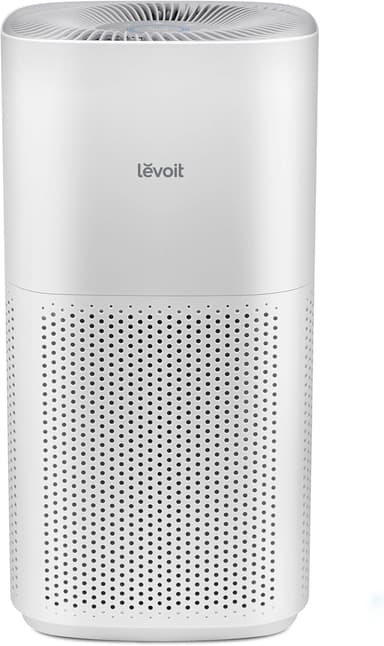
Levoit Core 600S Smart Air Purifier
$279.99
Levoit's most powerful home air purifier for large spaces up to 635 sq ft. With a CADR of 410 CFM, built-in laser PM2.5 sensor, and auto-mode intelligence, the Core 600S is the go-to for open-plan living rooms and large bedrooms.
- 410 CFM CADR — covers up to 635 sq ft per cycle
- Built-in laser PM2.5 sensor for auto-mode intelligence
- True H13 HEPA with pet-allergen pre-filter
As an Amazon Associate we earn from qualifying purchases. Prices updated regularly.
For open floor plans, a higher-capacity unit like the Levoit Core 600S (rated for up to 1,588 sq ft at 1 air change per hour) can keep pace with the volume of air affected by cooking in a connected kitchen-living space. Run it on auto mode so it ramps up automatically when its built-in laser PM2.5 sensor detects a cooking spike.
Coway
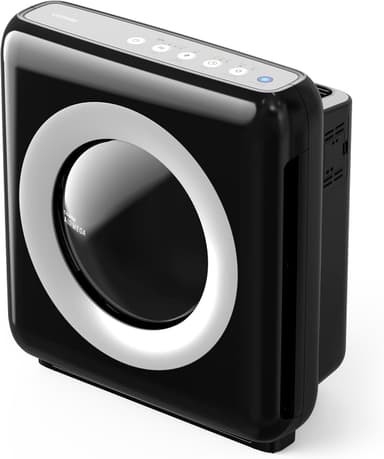
Coway AP-1512HH Mighty Air Purifier
$89.99
Best-selling 4-stage filtration air purifier for rooms up to 360 sq ft. True HEPA + activated carbon + ionizer.
- Exceptional value for HEPA filtration
- Auto mode with real air quality sensing
- Quiet operation (sleep mode)
As an Amazon Associate we earn from qualifying purchases. Prices updated regularly.
For smaller or more enclosed kitchens, the compact and well-reviewed Coway AP-1512HH Mighty offers strong value — its activated carbon layer also helps with cooking odors (fried fish, fried onions, curry) that can otherwise linger in fabrics and cabinetry for hours. Note that air purifiers do not remove gases like NO2 or CO effectively — they're a complement to ventilation, not a replacement for it. For that reason, a working range hood (or open window) remains step one regardless of what purifier you add.
Cooking Methods That Produce the Least Pollution
If you're cooking in a kitchen with limited ventilation — a small apartment kitchenette, for example — your choice of cooking method matters more than you might think:
Lower-emission methods
- Boiling, steaming, and poaching — minimal particulate and VOC release
- Slow cooking and pressure cooking — sealed environments produce far less airborne byproduct
- Baking and roasting at moderate temperatures — lower particle emissions than stovetop frying
- Induction cooktops — eliminate combustion gases entirely (no NO2 or CO), and heat the pan more efficiently with less ambient heat
Higher-emission methods
- Deep-frying and pan-frying — oil heated near or past its smoke point releases significant PM2.5 and aldehydes
- Stir-frying / wok cooking on high heat — among the highest particle-generating cooking methods measured in field studies
- Broiling and searing — generates ultrafine particles that linger and are harder to filter
- Any gas burner use without ventilation — NO2 accumulates regardless of what's being cooked
None of this means giving up your favorite dishes — it just means that on nights when you're searing a steak or making a stir-fry, that's exactly when the range hood, an open window, and your air purifier earn their keep.
Special Considerations for Gas Stove Households
If your home uses a gas range, a few additional precautions are worth building into your routine:
- Have your stove's combustion checked periodically. A poorly tuned burner produces more CO and NO2 than a well-maintained one. If you notice a yellow (rather than blue) flame, that's a sign of incomplete combustion worth having a technician look at.
- Install a CO alarm in or near the kitchen in addition to any required by code elsewhere in the home — most code-mandated alarms are placed near bedrooms, not kitchens.
- Avoid using the oven to heat the kitchen in cold weather, even briefly — ovens aren't designed for unvented space heating and can allow CO and NO2 to build up.
- Consider your range hood's "make-up air" needs. High-CFM hoods (typically 400+ CFM) can depressurize a tightly sealed home enough to pull combustion gases back from a furnace or water heater flue. If you're installing or upgrading a powerful hood, ask your contractor whether a make-up air damper is needed.
None of this is meant to alarm gas-stove owners — millions of households cook on gas safely every day. The point is simply that gas combustion adds NO2 and CO to the pollutant list, both of which respond well to the same ventilation habits that help with particles and odors.
Putting It Together: A Practical Cooking Routine
- Before you start cooking, turn on the range hood (or open a window) — don't wait until smoke appears.
- Use the back burners with the hood when possible, and make sure the hood is sized to cover them.
- For high-heat methods (frying, searing, wok cooking), run the hood on its highest setting.
- Keep ventilation running for 5–10 minutes after you finish cooking — pollutants don't disappear the moment the burner turns off.
- Run an air purifier in or near the kitchen, ideally on auto mode so it responds to spikes automatically.
- Check your air quality monitor periodically to confirm PM2.5 and NO2 (if your monitor tracks it) return to baseline within a reasonable time after cooking.
If you're also dealing with elevated CO2 from a tightly sealed kitchen — common in newer, well-insulated homes — our guide on how indoor CO2 affects sleep and focus covers ventilation strategies that overlap nicely with cooking pollution control. And if your household includes anyone with asthma or allergies, our guide to the best air purifiers for allergies goes deeper on filtration choices that also help with cooking-related irritants.
Frequently Asked Questions
Is cooking pollution really comparable to outdoor air pollution?
In terms of short-term concentration, yes — and sometimes it's worse. The Stanford research cited above found that NO2 levels during gas stove use can exceed the EPA's outdoor 1-hour standard within just a few minutes of turning on a burner. The difference is duration and proximity: outdoor pollution events can last hours and affect a whole neighborhood, while cooking spikes are shorter but happen at close range, repeatedly, in a space you spend hours in daily.
Do electric and induction stoves solve the problem entirely?
They eliminate combustion gases (NO2, CO) entirely, which is a meaningful improvement. But they don't eliminate particulate matter and VOCs from the cooking process itself — oil smoke, aldehydes from heated fats, and particles from browning food are produced regardless of heat source. Ventilation still matters with electric and induction cooking, just for a narrower set of pollutants.
Will an air purifier alone solve my cooking pollution problem?
Not on its own. Air purifiers are very effective at removing particulate matter (PM2.5, smoke, odors via carbon filters) but they do essentially nothing for gaseous pollutants like NO2 and CO, which are only addressed by ventilation (exhaust to outdoors or fresh air exchange). Think of ventilation as your first line of defense and an air purifier as a complement that handles particles ventilation misses.
My range hood is loud — is it worth running for short cooking tasks?
Yes, even at a lower fan speed. Some ventilation during cooking is significantly better than none — running the hood on its lowest setting for a quick task like toasting or reheating still helps clear humidity, odors, and minor particulates. Save the highest setting for frying, searing, and wok cooking, where pollutant generation is highest.
How long should I keep my air purifier running after cooking?
If it's on auto mode with a built-in particle sensor, it will naturally run at higher speed during and after cooking until levels return to baseline, then drop back to a quieter setting — typically 30–60 minutes for a significant cooking event. If your purifier doesn't have auto mode, manually running it on a higher setting for 30–45 minutes after high-heat cooking is a reasonable rule of thumb.
Should I be worried about cooking pollution if no one in my household has asthma or respiratory issues?
The research on long-term, low-level exposure to cooking pollutants is still developing, but the general principle in indoor air quality is that reducing unnecessary exposure to combustion byproducts and fine particles is a reasonable precaution for everyone — not just those with existing conditions. The good news is that the fixes (ventilation habits, a monitor, an air purifier) are inexpensive, low-effort, and benefit overall air quality in ways that go well beyond cooking.
The Bottom Line
Cooking is one of the most consistent — and most overlooked — sources of indoor air pollution in the average home. The fixes don't require a kitchen renovation: use your range hood every time you cook, especially for high-heat methods, and crack a window when you can. Add an Airthings View Plus (or a budget monitor like the Govee Air Quality Monitor) to see exactly how your kitchen responds to cooking and ventilation in real time. Then let an air purifier — the Levoit Core 600S for open-concept spaces or the Coway AP-1512HH Mighty for smaller kitchens — handle the particles and odors that ventilation alone doesn't catch.
Together, these steps address the full spectrum of cooking pollutants — gases, fine particles, and ultrafine particles — without changing how or what you cook. Have questions about setting up monitoring or choosing the right purifier for your kitchen layout? Reach out to our editorial team — we're happy to help.