Nursery Air Quality: A New Parent's Complete Guide to Clean Air for Your Baby
Babies spend up to 18 hours a day in their nursery — and their lungs are still developing. Here's what actually affects air quality in your baby's room, and exactly what to do about it.

Affiliate Disclosure
HomeAirWise participates in the Amazon Associates program and other affiliate partnerships. When you click a product link and make a purchase, we may earn a small commission at no additional cost to you. This helps us maintain the site and continue providing independent research and recommendations. Read our full disclosure.
Your baby's nursery is where they'll spend most of their first year of life — up to 16 to 18 hours a day sleeping, napping, and being held. It's also a room that, despite your best intentions, can harbor a surprising mix of indoor air quality concerns: off-gassing from new furniture and mattresses, excess humidity that breeds mold, fine particles from nearby rooms, and in some homes, elevated radon levels in the first-floor or basement room you chose for the nursery.
None of this is cause for alarm — a nursery with good air quality is entirely achievable and doesn't require expensive renovation. What it does require is understanding which threats actually matter, and making a handful of targeted, well-timed choices about ventilation, filtration, and monitoring. This guide walks through the full picture, from the specific reasons infant lungs are more vulnerable to the exact products and habits that make the biggest practical difference.
Why Infant Lungs Are More Vulnerable Than Adults'
Babies aren't just small adults when it comes to air quality — their exposure risk is genuinely different:
- Faster breathing rate. Newborns breathe 30–60 times per minute compared to an adult's 12–20. This means they pull in substantially more air per unit of body weight, and with it, proportionally more of whatever is in that air.
- Lung development continues after birth. The airways and alveoli continue developing for the first several years of life. This period of active growth makes lung tissue more sensitive to chemical irritants, particulate matter, and oxygen-depleting environments than adult tissue.
- They spend most of their time in one room. An adult who works, commutes, and moves between spaces has their indoor exposure averaged across multiple environments. A sleeping infant's entire air quality exposure is dominated by a single room — the nursery. Whatever is in that room is what they breathe, continuously, for 16+ hours a day.
- They can't communicate discomfort. A child with a sore throat from dry air or nasal irritation from off-gassing VOCs will cry more, sleep less, and show other non-specific symptoms that are easily misattributed to other causes. Air quality issues in nurseries are chronically underdetected precisely because babies can't describe what's bothering them.
The World Health Organization's guidelines on indoor air quality specifically note that children under five are among the most vulnerable populations for indoor air pollution exposure — and a baby's nursery is often the highest-risk indoor microenvironment in the house.
The Biggest Air Quality Concerns in a New Nursery
VOCs and off-gassing from new furniture and finishes
A newly furnished nursery can have significantly elevated levels of volatile organic compounds (VOCs) in the first weeks after setup. Cribs, dressers, gliders, and changing tables made from pressed wood or MDF often contain formaldehyde-based adhesives (urea-formaldehyde and phenol-formaldehyde) that off-gas for weeks to months, particularly in warm rooms. The EPA classifies formaldehyde as a probable human carcinogen, with the National Cancer Institute noting that chronic low-level exposure is associated with respiratory irritation and, at higher levels, nasopharyngeal cancer.
New crib mattresses — even foam mattresses marketed as "organic" — can also off-gas a mix of VOCs including acetaldehyde, methyl isobutyl ketone, and flame-retardant compounds. A 2007 study in Environmental Science and Technology detected VOC emissions from crib mattresses at concentrations higher than the mattresses' own surfaces, likely from infant body heat concentrating the gases. The fix isn't necessarily to buy a different mattress — it's to maximize ventilation in the weeks before the baby occupies the room, and to ensure ongoing fresh-air exchange once the room is in use.
New paint is another source, though low-VOC and zero-VOC latex paints have improved dramatically and reach near-background VOC levels within a few days of cure. If you painted the nursery, use genuine zero-VOC formula and allow at least two weeks of ventilation with windows open before the baby moves in.
Fine particulate matter (PM2.5) from adjacent spaces
PM2.5 — particles smaller than 2.5 microns — drifts freely through open doorways and HVAC systems from cooking, candles, cleaning products, and even outdoor infiltration. The EPA's current 24-hour PM2.5 standard is 35 µg/m³, but for a newborn's room, keeping average levels well below that — ideally in the single digits — is a reasonable aspirational target. A True HEPA air purifier running continuously in the nursery is the most effective intervention for this category of pollutant.
Humidity, condensation, and mold risk
Nurseries have unique humidity dynamics. Humidifiers — widely recommended by pediatricians to ease congestion and prevent dry skin — are effective but create a real mold risk if not managed carefully. The EPA recommends keeping indoor humidity between 30% and 50% year-round. Nurseries running humidifiers during winter heating season can easily push past 55–60% RH, which creates conditions hospitable to mold growth on walls, windowsills, and in carpet — especially in a tightly shut room. Our guides on mold prevention through humidity control and how to reduce indoor humidity cover the full framework; for a nursery specifically, the key practice is using a humidistat-enabled humidifier that shuts off above a target RH, and monitoring humidity continuously rather than guessing.
Radon accumulation in ground-level and basement nurseries
If your nursery is on the first floor or below grade, radon is worth testing before the baby moves in. Radon — a radioactive gas that rises from soil beneath foundations — accumulates at highest concentrations at the lowest levels of a home. The EPA's action level of 4 pCi/L applies to any occupied room, including nurseries. First-floor rooms typically test lower than basements, but in high-radon geology (much of the Midwest, Mountain West, and Pennsylvania), first-floor levels can still exceed the threshold. A short-term test kit is a straightforward, inexpensive precaution.
Step 1: Ventilate Before Move-In (Then Maintain Fresh Air)
The highest-impact intervention for VOC reduction is time and airflow. If possible, set up the nursery furniture four to eight weeks before the due date and ventilate aggressively — open windows, run a fan, and allow the room to air out while no one is sleeping in it. This timing takes advantage of the fact that off-gassing rates are highest in the first few weeks and decline exponentially. By the time the baby arrives, the bulk of the formaldehyde and VOC spike has already cleared.
If timing doesn't allow for pre-ventilation, increase the ventilation rate during early use: leave the nursery door open when possible, run a small fan to encourage air exchange with the rest of the house, and use your HVAC system's fan (set to "on" rather than "auto") to continuously circulate filtered air.
Step 2: Choose the Right HEPA Air Purifier for the Nursery
A nursery air purifier has a different priority profile than one for a living room or bedroom. The key criteria:
- True H13 HEPA filtration — not "HEPA-type" or "HEPA-style." H13 captures 99.95% of particles down to 0.1 microns. For a sleeping baby, this is the threshold that matters. See our detailed explainer on what HEPA actually means for why this distinction matters in practice.
- Quiet sleep mode. Nurseries require genuinely quiet operation at night — look for sleep/night modes rated below 25 dB. Many parents find that the white noise from a purifier's fan actually improves infant sleep, but only if it stays in that low-drone register rather than ramping up unexpectedly.
- Right-sized for the room. Match the unit's rated coverage to your nursery square footage, and target at least 4–5 air changes per hour (ACH) in the room. A unit rated for 219 sq ft at 4 ACH is appropriate for a typical 10×12 nursery; for larger rooms, size up.
- No ozone generation. Avoid any purifier that uses an ionizer, UV-C, or plasma wave mode that produces ozone as a byproduct. Ozone is a respiratory irritant at any concentration for adults; for a developing infant's airway, it's particularly worth avoiding. Stick to mechanical HEPA + activated carbon filtration.
- Auto mode with a particle sensor. A built-in PM2.5 laser sensor lets the unit ramp up automatically when it detects elevated particles (from cooking smells drifting in, for example) and return to quiet mode when the air is clean — so you don't have to manually adjust it during nighttime feeding.
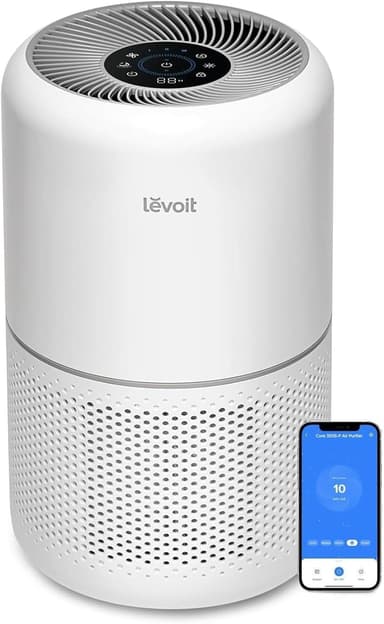
Levoit
Levoit Core 300S Smart Air Purifier
$99.99
Amazon's #1 bestselling air purifier with over 100,000 five-star reviews. True H13 HEPA filters 99.97% of 0.3-micron particles for rooms up to 219 sq ft, with whisper-quiet sleep mode and VeSync app control.
- Amazon's #1 bestselling air purifier with 100K+ reviews
- True H13 HEPA removes 99.97% of 0.3-micron particles
- Whisper-quiet at 24 dB in sleep mode
As an Amazon Associate we earn from qualifying purchases. Prices updated regularly.
The Levoit Core 300S is widely regarded as one of the best nurseries purifiers available, and the reasons are straightforward: it runs at as low as 24 dB on sleep mode (quieter than a whispered conversation), uses genuine H13 HEPA filtration, has a built-in PM2.5 sensor for auto mode, and generates zero ozone. It's compact enough (8.7 inches in diameter) to sit on a shelf or dresser without dominating the room, and the replacement filter cost is reasonable at roughly once a year under continuous nursery use. The Core 300S doesn't have an activated carbon layer as robust as larger units, but for a nursery focused primarily on particle control and not heavy VOC load, it's appropriately specified.
For larger nurseries over 300 sq ft, or if your nursery is in an open-plan space connected to a living area, a more powerful unit like the Winix 5500-2 or Levoit Core 600S (featured in our HEPA air purifier guide) may be necessary to achieve the target air change rate.
Step 3: Monitor What You Can't See
A monitor doesn't clean air — but it tells you when something is wrong, and it lets you verify that the steps you've taken are working. In a nursery specifically, the most useful metrics to track are:
| Metric | Target Range for Nursery | Why It Matters |
|---|---|---|
| PM2.5 | < 12 µg/m³ (annual avg) | Fine particles from cooking, candles, outdoor infiltration |
| Humidity (RH) | 40–50% | Prevents mold growth; prevents dry-air congestion |
| Temperature | 68–72°F (20–22°C) | Optimal infant sleep temperature (AAP guidance) |
| VOCs | Below 220 µg/m³ (TVOC) | Monitors off-gassing from new furniture and paint |
| CO2 | < 1,000 ppm | Indicates fresh air exchange; high CO2 signals poor ventilation |
| Radon | < 2 pCi/L (aspirational) | EPA action level is 4 pCi/L; lower is better in a child's room |
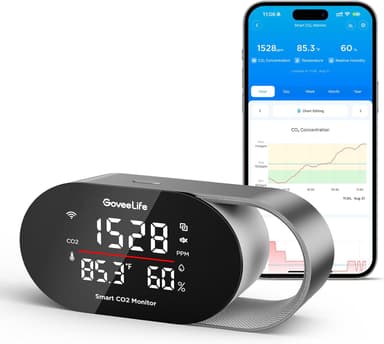
Govee
Govee Air Quality Monitor
$49.99
Budget-friendly indoor air quality monitor tracking PM2.5, CO2, TVOC, temperature, and humidity with a large color display.
- Very affordable for multi-sensor monitoring
- Large, clear color display
- Bluetooth app with historical data
As an Amazon Associate we earn from qualifying purchases. Prices updated regularly.
For most parents, a budget-friendly monitor that tracks PM2.5, humidity, temperature, and TVOC in real time covers the core nursery metrics. The Govee Air Quality Monitor does exactly that, with a clear color-coded display and a companion app that logs historical trends — useful for spotting patterns like humidity climbing too high overnight when the humidifier runs, or a PM2.5 spike when someone's cooking downstairs. Place it at crib level (not on a high shelf) to get the most relevant reading for where your baby actually breathes.
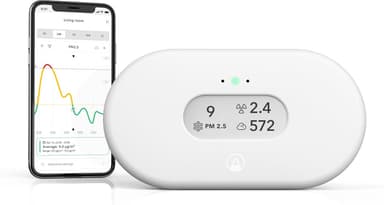
Airthings
Airthings View Plus
$299.99
The most comprehensive home air quality monitor available. Tracks radon, PM2.5, CO2, VOCs, humidity, temperature, pressure, and more.
- 7 sensors including radon AND PM2.5 (rare combination)
- Built-in e-ink color display
- Wi-Fi with real-time app access
As an Amazon Associate we earn from qualifying purchases. Prices updated regularly.
If you want a single device that covers the full nursery monitoring picture — including radon — the Airthings View Plus tracks PM2.5, CO2, VOCs, humidity, temperature, and radon simultaneously. At a higher price point than a dedicated radon detector, it's most cost-effective if you'd otherwise buy a monitor and radon detector separately. Its app-based interface provides long-term trend graphs and reference ranges, which are particularly useful in the first eight weeks when VOC levels from new furniture are declining and you want to verify the improvement is happening as expected. See our full indoor air quality monitor guide for a complete comparison of sensor accuracy across brands.
Step 4: Mold Prevention — Especially With a Humidifier Running
If you're using a humidifier in the nursery (a common recommendation for newborns), set it to maintain 45% RH — not "run continuously at max output." Every humidifier marketed to parents should ideally have a built-in humidistat that shuts off at your target level. If yours doesn't, use the room monitor to manually check humidity and adjust output. The risk zone for mold begins around 55–60% RH; windowsills, exterior walls, and floors near the humidifier are the first places to develop visible mold growth when a nursery runs too humid.
If you notice a musty odor in the nursery — especially after the room has been closed overnight — or if you see visible discoloration on walls or ceiling corners, act quickly. A mold test gives you a definitive answer and tells you whether professional remediation is warranted before your baby is exposed further.
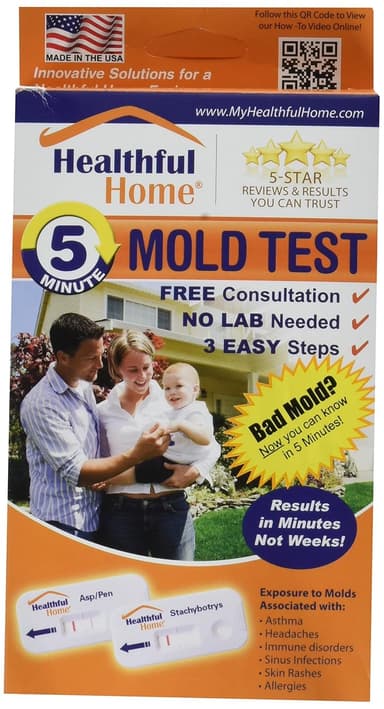
Healthful Home
Healthful Home 5-Minute Mold Test
$29.99
Quick at-home mold screening test with results in 5 minutes. No lab required. Detects common mold types.
- Results in 5 minutes (no lab wait)
- Easy to interpret results
- Good for spot-checking specific surfaces
As an Amazon Associate we earn from qualifying purchases. Prices updated regularly.
The Healthful Home 5-Minute Mold Test provides a rapid preliminary screen for common household molds including Aspergillus, Penicillium, and Stachybotrys (black mold). It's useful as a first diagnostic step when you smell something musty or see a suspect stain — it won't give you full quantification (for that, you'd want a professional air sample), but it quickly confirms whether mold is present and what type. For nurseries in older homes or those with a history of water intrusion, testing before the baby arrives is a reasonable precaution.
What You Don't Need (And What to Avoid)
The nursery air quality market is full of products marketed at anxious new parents that range from unnecessary to actively counterproductive:
- Ozone generators or "air ionizers." Marketed as "clean air" solutions, ozone generators deliberately produce ozone — a lung irritant at the concentrations needed to kill pathogens. The EPA explicitly warns against using them in occupied spaces. Any purifier with an ionizer or plasma mode should have that function disabled (or avoided entirely) in a nursery.
- Essential oil diffusers. Volatile compounds from essential oils (even lavender and eucalyptus) add VOC load to the nursery's air. Several commonly diffused oils contain compounds that are respiratory irritants for infants. The American Academy of Pediatrics recommends against use in infants' rooms.
- Scented candles or air fresheners. These generate VOCs and fine particulate matter. Unscented candles still produce soot particles that HEPA purifiers have to work harder to clear.
- Heavily scented cleaning products. Clean the nursery with fragrance-free cleaners and ventilate well before the baby is returned to the room.
For a broader framework on what the signs of indoor air quality problems look like and how to diagnose them room by room, our complete guide to home air quality testing covers the full sequence.
Frequently Asked Questions
Should I run an air purifier in the nursery 24/7?
Yes — continuous low-level operation (in auto or sleep mode) is more effective than running on high for a few hours. A purifier on auto mode maintains a consistent particle load in the room and ramps up automatically when something triggers the sensor. The energy draw at low speeds is minimal (typically 5–15 watts). The Levoit Core 300S is designed for this use case and is quiet enough that continuous overnight operation doesn't disturb infant sleep.
Where should I place the air purifier in the nursery?
On the floor or a low shelf, a few feet from the crib but not blowing directly at the sleeping area. Most HEPA purifiers draw air in from the sides and expel it upward, so positioning them 2–4 feet from the crib captures air in the baby's breathing zone without creating a direct draft. Avoid placing the unit in a corner, which restricts intake airflow and reduces efficiency by 10–15%.
Do I need both a humidifier and a purifier?
They serve different purposes. A purifier removes particles and some VOCs; it does nothing for humidity. A humidifier raises moisture levels to prevent dry-air congestion and skin irritation. If your pediatrician recommends a humidifier (especially for sick or congested infants), use one — just monitor humidity to keep it at 40–50% and prevent it from climbing into mold-risk territory. The two devices are complementary, not redundant.
Is new crib mattress off-gassing really dangerous?
The short answer is: elevated VOC emissions from new mattresses are real, measurable, and worth minimizing, but the direct health risk from a compliant crib mattress is not clearly established at typical concentrations. The practical precaution — unwrap the mattress, allow it to air out for a week in a ventilated space before placing it in the crib, and ventilate the nursery well in early use — is low-cost and eliminates most of the concern. If you're worried about formaldehyde specifically, look for mattresses certified to GREENGUARD Gold standards, which require testing under conditions representative of a child's sleeping environment.
Is my nursery radon level safe?
The only way to know is to test. A short-term charcoal test (placed in the nursery for 48–96 hours, then mailed to a lab) costs about $15–30 and gives you a specific number. If the result is below 2 pCi/L, you're in good shape. Between 2–4 pCi/L, consider a long-term follow-up test and discuss with a certified radon mitigator. Above 4 pCi/L (the EPA's action level) in any room where your baby sleeps, mitigation is warranted before the nursery is occupied. See our guide to radon mitigation systems for how the remediation process works and what it typically costs.
What about air quality when visiting family — how do I protect my baby in other people's homes?
Travel-sized purifiers (there are mini USB-powered HEPA units) help in short stays, though their coverage is limited. The most practical measures are opening windows in the room where your baby sleeps, keeping the space clear of fragrances and candles, and asking hosts who smoke to do so outside. Radon and VOC monitoring while traveling isn't practical for most families — reserve that investment for your own home where your baby spends the vast majority of their time.
The Bottom Line
Clean nursery air comes down to a handful of well-timed decisions rather than a long list of ongoing purchases. Before your baby arrives: ventilate the newly furnished room aggressively for several weeks, test for radon if you're on the first floor or below, and paint with genuine zero-VOC formula well in advance. Once the room is in use: run a Levoit Core 300S (or comparably quiet H13 HEPA purifier) continuously on auto mode to keep particles low; use a monitor like the Govee Air Quality Monitor to track humidity, PM2.5, and VOCs in real time; and if you want radon included in the monitoring picture, the Airthings View Plus covers all of it in one device. If you're using a humidifier, keep it set to 45% RH rather than running on maximum — and check monthly for early signs of moisture accumulation on walls or windowsills, using the Healthful Home 5-Minute Mold Test if anything looks suspect.
None of these steps are complicated, and none require breaking the budget. Babies are remarkably resilient — the goal here isn't a clinical clean room, it's simply giving developing lungs an environment without unnecessary chemical load, particles, or moisture problems that can easily be prevented with a little forethought.