Why Winter Is the Best Time to Test for Radon: Closed-House Conditions Explained
The same house can produce a radon reading twice as high in January as it does in June. Here's the physics behind that swing — and why testing labs insist on 'closed-house conditions' for accurate results.

Affiliate Disclosure
HomeAirWise participates in the Amazon Associates program and other affiliate partnerships. When you click a product link and make a purchase, we may earn a small commission at no additional cost to you. This helps us maintain the site and continue providing independent research and recommendations. Read our full disclosure.
If you tested your home for radon in July with the windows open and the whole family in and out of the back door all day, and then tested again in January with everything sealed up and the furnace running, you would not be measuring the same house. You'd be measuring two different air-exchange systems that happen to share a foundation. The radon reading could easily double.
This isn't a quirk or a measurement error — it's physics, and it's exactly why the protocols that accredited radon labs and the EPA publish for short-term testing specify something called "closed-house conditions." Understanding what that means, and why winter naturally satisfies it, is the difference between a radon test that tells you the truth about your home and one that just tells you what your home was doing on a mild, breezy afternoon. If you haven't tested at all yet, our overview of what radon is and why the EPA recommends testing every home is a good starting point before you dig into timing.
The Short Version: Winter Concentrates Radon, and Testing Protocols Assume That
Radon gas seeps continuously out of the soil beneath your home, at a rate that stays fairly constant year-round regardless of season. What changes with the seasons isn't how much radon enters your home — it's how much fresh outdoor air is diluting it and how strongly your house is pulling soil gas in through its foundation in the first place. In winter, both of those factors push in the same direction: less dilution, and a stronger vacuum effect pulling soil gas upward into your living space. The result is that most homes read highest in the coldest months and lowest in the mildest ones.
That's why the EPA's own guidance recommends conducting short-term radon tests under "closed-house conditions" — and why winter, when houses are naturally sealed up against the cold, tends to produce closed-house conditions without you having to think about it. Summer testing requires you to deliberately keep windows shut and avoid excessive ventilation, which is unnatural behavior in warm weather and easy to accidentally violate.
The Stack Effect: Why Your House "Breathes" Radon In
The mechanism behind winter's higher readings has a name: the stack effect (sometimes called the chimney effect). It's the same physical principle that makes a fireplace draw and a tall building's elevator shafts whistle in cold weather.
Warm air is less dense than cold air, so it rises. Inside a heated home in winter, warm indoor air rises and escapes through small gaps at the top of the house — around attic hatches, recessed lighting, chimney chases, and upper-floor window and door seals. As that warm air leaves through the top of the house, it has to be replaced by air pulled in from somewhere lower. Some of that replacement air comes from outside through gaps at ground level. But a significant portion gets pulled from directly beneath the house — through the soil, through cracks in the foundation slab, through the sump pit, through gaps around pipe penetrations — because the path of least resistance for a house under negative pressure is often straight up through the crawl space or basement floor.
The bigger the temperature difference between inside and outside, and the taller the house, the stronger this effect becomes. A three-story home in Minnesota in January experiences a dramatically stronger stack effect than a single-story home in Georgia in October — which is part of why radon risk maps correlate loosely with both geology and climate. The soil gas doesn't change with the seasons nearly as much as the vacuum pulling it inward does.
| Condition | Effect on Stack Effect | Effect on Radon Level |
|---|---|---|
| Cold outdoor temperature | Stronger indoor/outdoor pressure differential | Higher — more soil gas pulled in |
| Furnace/heating system running continuously | Reinforces warm-air-rises cycle | Higher |
| Windows and doors closed | Less passive dilution from outdoor air | Higher |
| Mild outdoor temperature (spring/fall) | Weak or near-zero pressure differential | Lower |
| Windows open, cross-ventilation | Active dilution with outdoor air | Lower |
| Bathroom/kitchen exhaust fans running heavily | Can create additional negative pressure indoors | Can increase, depending on makeup air source |
What "Closed-House Conditions" Actually Requires
If you've bought a radon test kit before, you've probably seen the instruction sheet mention closed-house conditions without much explanation of why they matter. For a short-term test (2–90 days, most commonly 2–7 days for charcoal-based kits), the protocol generally requires:
- Windows and exterior doors closed except for normal entry and exit, for at least 12 hours before the test starts and for the entire duration of the test
- No operation of whole-house fans or window fans that exchange large volumes of indoor and outdoor air
- Minimal use of exhaust fans (bathroom, kitchen range hood) — brief use is fine, but avoid running them continuously
- No fireplace or wood stove operation if it draws combustion air from inside the house, since this can pull additional soil gas in through the same negative-pressure mechanism
- HVAC systems can run normally in their standard heating/cooling mode, since this doesn't introduce outdoor air the way an exhaust fan or open window does
Notice what this list amounts to: it's simply describing how most houses already behave on a cold day in January, without anyone having to try. Nobody leaves windows open in a Wisconsin winter, and running the furnace is the default rather than a special instruction. Compare that to a mild June afternoon, when leaving a window cracked for fresh air, running a box fan, or grilling on the back porch with the kitchen door propped open are all completely normal — and every one of them can suppress your radon reading below what the house would show under sealed conditions.
Does That Mean Summer Test Results Are Wrong?
Not wrong, exactly — but potentially not representative of your home's worst-case exposure. A summer test conducted under genuinely closed-house conditions (windows shut, minimal fan use, for the full test period) is still a valid measurement. The problem is compliance: it's much easier to accidentally violate closed-house conditions in summer because keeping a house sealed up when it's 85°F outside runs against every instinct, and one afternoon of open windows partway through a 4-day test can meaningfully skew the average.
If you do need to test in summer — before a home sale that's happening regardless of season, for example — your options are:
- Commit fully to closed-house conditions for the entire test period, running air conditioning instead of open windows for cooling
- Use a long-term test (90 days to a full year) with a continuous digital monitor instead of a short-term charcoal kit. Long-term results average out seasonal swings and don't require closed-house conditions, because they're measuring your home's actual year-round exposure rather than trying to isolate a single condition
- Retest in winter as a second data point, particularly if a summer short-term test came back in the 2–4 pCi/L range where the result could reasonably tip your decision either direction
Why This Matters More at the EPA Action Level Threshold
The EPA's mitigation threshold is 4.0 picocuries per liter (pCi/L). A home that averages 3.2 pCi/L year-round might test at 2.1 pCi/L in July under relaxed summer ventilation and 4.6 pCi/L in January under true closed-house winter conditions — both technically accurate readings for the conditions under which they were taken, but telling very different stories about whether mitigation is warranted. This is precisely the scenario closed-house testing protocols exist to prevent: a homeowner concluding "we're fine" based on a reading taken during the one season least representative of the exposure they're actually getting for the other nine months of the year.
This is also why radon testing during a home purchase can produce results that surprise sellers who tested years earlier in a different season, and why a single test — regardless of season — is never as reliable as the kind of continuous, multi-season monitoring a digital detector provides.
Short-Term vs. Long-Term Testing: Which Fits a Winter Test?
| Test Type | Duration | Closed-House Conditions Required? | Best Use Case |
|---|---|---|---|
| Short-term charcoal/alpha-track | 2–7 days (some up to 90) | Yes, strictly, for the full test period | Fast initial screening, real estate transactions with tight timelines |
| Long-term alpha-track | 90 days–1 year | No — designed to reflect normal seasonal living patterns | Establishing your home's true annual average exposure |
| Continuous digital monitor | Ongoing, with daily/hourly readings | No — shows you the swings themselves | Tracking how much your radon level actually changes between seasons |
If you want to actually see the winter-versus-summer swing in your own home rather than take it on faith, a continuous digital monitor is the only test type built for that. It logs daily readings you can graph over a full year, which is the clearest way to understand your own house's stack-effect behavior — some homes swing 3x between seasons, others barely move, depending on foundation type, house height, and how airtight the building envelope is.
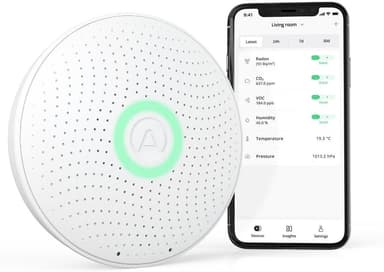
Airthings
Airthings Wave Plus
$229.99
Smart radon detector with 6-in-1 air quality monitoring including CO2, VOCs, humidity, temperature, and pressure.
- Professional-grade radon sensor validated by NILU
- Monitors 6 pollutants simultaneously
- Continuous hourly readings (not just a snapshot)
As an Amazon Associate we earn from qualifying purchases. Prices updated regularly.
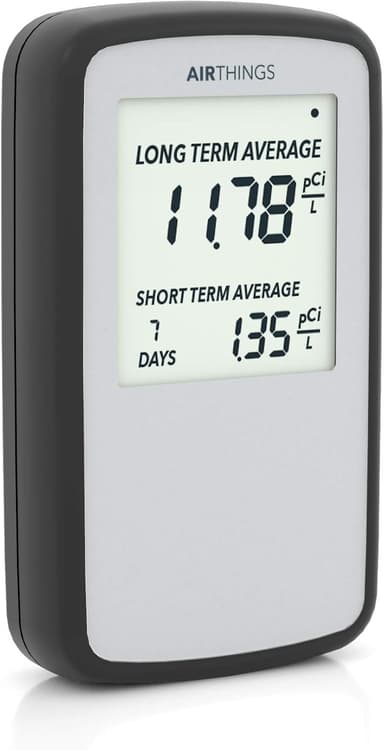
Airthings
Corentium Home Radon Detector
$89.99
Simple, reliable battery-powered radon detector with a clear digital display. No app required.
- Simple, no app or Wi-Fi needed
- Clear 3-number display (day/week/long-term)
- 2-year battery life
As an Amazon Associate we earn from qualifying purchases. Prices updated regularly.
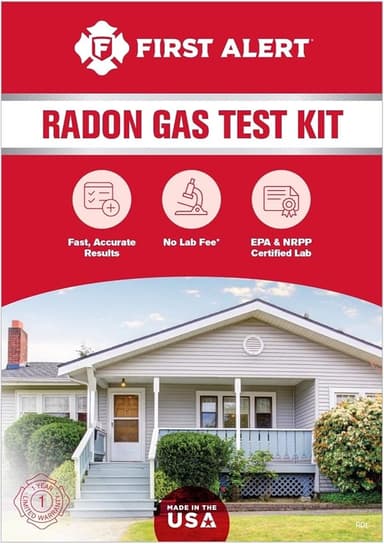
First Alert
First Alert Radon Gas Test Kit, RD1
$18.98
EPA-listed short-term charcoal radon test. Place for 48–96 hours, mail to lab, get email results in 72 hours. Amazon's Choice with 10K+ reviews.
- Most affordable EPA-listed home radon test
- Lab fees included (except NJ); results emailed within 72 hours
- Amazon's Choice with 10,000+ verified reviews
As an Amazon Associate we earn from qualifying purchases. Prices updated regularly.
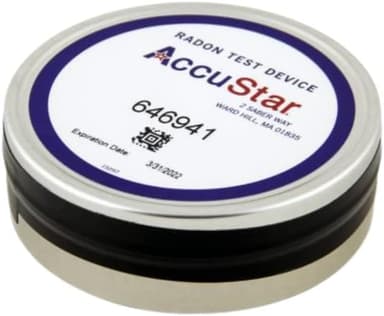
AccuStar Labs
AccuStar Charcoal Short-Term Radon Test Kit
$14.99
The most widely used EPA-recognized short-term radon test in the US, trusted by home inspectors and real estate professionals. Activated charcoal canister delivers accurate 48–96 hour results with certified lab analysis included.
- Most trusted lab brand for real estate radon testing
- EPA-recognized and NRPP-certified methodology
- Prepaid lab return envelope included — no extra fees
As an Amazon Associate we earn from qualifying purchases. Prices updated regularly.
Practical Tips for a Clean Winter Test
- Start the closed-house period 12 hours before you place the kit or start the digital monitor, not the moment you begin the test. Labs specifically ask for this lead-in window so the house has time to reach its normal winter equilibrium.
- Place the detector in the lowest lived-in level of the home — typically a basement family room or the lowest floor used regularly, not a utility crawl space or unfinished storage area. See our guide on testing in the basement versus the first floor for placement specifics.
- Keep the detector away from drafts, exterior walls, and heating vents, which can create localized air currents that skew a reading independent of the home's actual radon level.
- Avoid testing during an unusual cold snap or an unusual warm spell if you can help it — a polar vortex week will likely read higher than a typical winter week, and an unseasonable January thaw will likely read lower. A representative average winter week gives the most useful number.
- Don't schedule a short-term test around a period of planned renovation, painting, or heavy cleaning that involves extra exhaust fan use, since that can suppress the reading during exactly the window you're trying to measure accurately.
What to Do With a High Winter Reading
If your winter closed-house test comes back at or above 4.0 pCi/L, the EPA's recommendation is mitigation, typically through a sub-slab depressurization system. Our guide to how radon mitigation systems work covers the installation process and what it costs. It's worth noting that a winter reading above the action level is, if anything, a more conservative and more actionable result than a borderline summer one — you've caught your house at its highest-exposure season, which means you're not underestimating the problem.
If you're planning a basement renovation or finishing a previously unfinished lower level, a winter test is particularly valuable to run beforehand, since a finished basement will change airflow patterns and it's easier to plan mitigation infrastructure before drywall goes up than after.
Frequently Asked Questions
Can I just wait for winter if I'm testing right now in summer?
If there's no urgent deadline (like a real estate closing), waiting for winter — or running a long-term test that spans both seasons — will give you a more representative picture. If you need results now, follow closed-house protocol strictly for the full summer test period rather than skipping the test altogether.
Does running my furnace during the test affect the reading?
Normal furnace operation is expected and fine — it's part of what closed-house winter conditions look like. What you want to avoid is anything that actively exchanges large volumes of indoor and outdoor air, like a whole-house fan, not standard heating.
My house tested low in winter — does that mean I'm definitely safe?
A low reading taken under strict closed-house winter conditions is one of the more reassuring results you can get, since winter tends to represent your home's higher-exposure season. It's still not a lifetime guarantee — retest periodically (the EPA suggests every 2 years, and after any major renovation or foundation work) since radon entry points can change over time.
Why does my neighbor's identical house test differently than mine?
Even structurally identical homes can have meaningfully different radon levels due to variations in foundation cracking, sump pit sealing, soil composition immediately under each specific foundation, and how tightly each house's envelope is sealed. Testing your own home is the only way to know your own number.
Is a digital continuous monitor worth it over a one-time short-term kit?
If you want to understand your home's real seasonal pattern rather than a single snapshot, yes — a continuous monitor is the only tool that shows you the swing itself rather than requiring you to infer it. For a quick, low-cost first check, a short-term kit under proper winter closed-house conditions is a perfectly reliable starting point.
Do apartment or condo units need to worry about the stack effect?
Ground-floor and lower-level units are affected by the same soil-gas entry mechanisms as single-family homes. Upper-floor units in multi-story buildings are generally at lower risk from soil-gas radon specifically, though building-wide HVAC and stairwell pressure dynamics can still create localized variation worth testing for if you're on a lower floor.
Should radon be the only thing I test for in winter?
No — closed-house conditions affect more than radon. VOCs, CO2, and humidity-driven mold risk can all shift when a house is sealed up for the season too. Our complete beginner's guide to testing your home's air quality covers how to build a full seasonal testing routine rather than checking radon in isolation.
The Bottom Line
Radon doesn't get seasonal amnesia — the soil under your house releases it at roughly the same rate in July as it does in January. What changes is how effectively your house pulls that gas indoors and how much fresh air dilutes it once it arrives, and both of those factors swing hard toward "more radon indoors" in cold weather. That's exactly why winter, with its naturally sealed-up houses and running furnaces, tends to produce the closed-house conditions that testing protocols require — and why a winter test is often the most honest number your home will give you.
If you want a single accurate snapshot, a short-term kit like the First Alert RD1 or AccuStar Charcoal Short-Term Test run during a typical cold-weather week, with strict closed-house conditions for the full test period, will get you there. If you want to actually see your home's seasonal pattern rather than guess at it, an Airthings Wave Plus or Corentium Home Radon Detector running year-round will show you the real swing between your highest- and lowest-exposure months — and take the guesswork out of when to test altogether.