Best Air Purifiers for Your Bedroom in 2026: Quiet, Effective, and Sleep-Tested
Your bedroom is where you spend a third of your life — and it's where air quality has the clearest measurable impact on how you sleep, recover, and feel in the morning. Here's what actually matters when choosing a purifier for this room, and which models deliver.

Affiliate Disclosure
HomeAirWise participates in the Amazon Associates program and other affiliate partnerships. When you click a product link and make a purchase, we may earn a small commission at no additional cost to you. This helps us maintain the site and continue providing independent research and recommendations. Read our full disclosure.
A bedroom air purifier has to earn its keep differently than one you run in a living room or home office. It needs to be genuinely quiet — quiet enough that you stop noticing it within five minutes of lying down, not just tolerably quiet. The display can't function as a nightlight. The auto mode needs to be smart enough to ramp up when air quality slips without waking you. And it needs to be sized correctly for the room, because an undersized unit running on high to compensate is both noisier and less efficient than a properly matched unit running on low.
These constraints eliminate most of the air purifiers on the market, even ones that perform well in other contexts. This guide focuses specifically on the bedroom use case: what the research says about nighttime air quality and sleep, what specifications actually matter, and which purifiers are worth putting in the room where you spend roughly a third of your life.
Why Bedroom Air Quality Has an Outsized Effect on Your Health
The bedroom is uniquely important for air quality exposure for two reasons: duration and physiological state. During sleep, you're in one room for 7–9 continuous hours — a longer uninterrupted exposure window than almost any other indoor environment. And during sleep, your respiratory system is running at a consistent baseline rate without the behavioral interruptions (moving rooms, opening windows, going outside) that break up daytime exposure.
Research on the connection between bedroom air quality and sleep outcomes has strengthened considerably over the past decade. A 2017 study published in Indoor Air found that subjects sleeping in rooms with higher PM2.5 concentrations had measurably shorter slow-wave (deep) sleep duration and more nighttime awakenings, even at concentrations below the EPA's 24-hour standard of 35 µg/m³. A 2019 study in Science of the Total Environment linked bedroom CO2 levels above 1,000 ppm to reduced next-day cognitive performance — a finding consistent with what we know about CO2's effects on cerebral blood flow. We covered this in detail in our piece on how indoor CO2 affects sleep and focus.
The practical upshot: a bedroom air purifier that reliably keeps PM2.5 below 10 µg/m³ overnight is doing something measurable for your health — not just providing peace of mind. The question is which units actually deliver that performance without creating the secondary problem of sleep-disrupting noise.
What Makes a Bedroom Air Purifier Different
For a living room or office purifier, the priority list runs roughly: effectiveness, coverage, filter cost. For a bedroom, you need to add three bedroom-specific criteria that can override the others:
1. Noise level in sleep mode
The relevant number is the decibel rating at the unit's lowest speed setting — not the advertised "lowest noise" figure, which is sometimes measured under lab conditions that don't reflect continuous operation. Look for units rated at 24–26 dB or lower on their sleep/night mode. For context, 30 dB is about the level of a quiet library; 25 dB approaches the threshold of perception in a quiet room. Most adults can sleep through 30–35 dB of continuous white noise, but anything above that on a variable fan — particularly with mechanical hum — tends to be disruptive for lighter sleepers.
Auto mode is important here precisely because it lets the unit run quietly most of the time and only ramp up when the particle sensor detects elevated levels (from cooking smells drifting in, a partner arriving home late, or morning activity). A purifier in a closed bedroom on auto will rarely need to run above its lowest speed for most of the night.
2. Display brightness and controllability
This sounds trivial but isn't. A blue or white LED indicator visible from the bed is enough to disrupt melatonin production for light-sensitive sleepers. Look for units with an automatic display-off mode triggered by the sleep/night setting, or a manual display dimmer that goes to fully off. Units that only dim to "low" rather than fully extinguishing the display are worth noting in the product sections below.
3. Sizing: CADR matched to the room, not overrated
The EPA and AHAM recommend targeting at least 4–5 air changes per hour (ACH) in the room. For a standard 12×12 ft bedroom (144 sq ft at 8 ft ceilings = 1,152 cubic feet), 4 ACH requires a CADR of at least 77 CFM. For a larger 15×18 ft master bedroom (270 sq ft, same ceiling height = 2,160 cubic feet), you need at least 144 CFM CADR to hit 4 ACH. The practical rule: don't buy a unit rated for 150 sq ft and run it on high in a 250 sq ft room — buy a unit rated for 300+ sq ft and run it on low or auto.
Our general HEPA air purifier guide covers CADR calculations in more depth; below we apply those principles specifically to bedroom sizing scenarios.
Bedroom Air Purifier Comparison at a Glance
| Model | Coverage (sq ft) | Sleep Mode (dB) | Display Off? | Filter Type | Best For |
|---|---|---|---|---|---|
| Levoit Core 300S | 219 | 24 dB | Yes (full off) | H13 HEPA + carbon | Small bedrooms, quiet priority |
| Winix 5500-2 | 360 | 27.8 dB | Yes (sleep mode) | True HEPA + carbon | Medium to large rooms, all-around |
| Coway AP-1512HH | 360 | 24.4 dB | Yes (sleep mode dims to off) | True HEPA + carbon | Budget, medium rooms |
| Levoit Core 600S | 635 | 26 dB | Yes (full off) | H13 HEPA + carbon | Large master bedrooms, open layouts |
The Best Bedroom Air Purifiers in 2026
Best for Small Bedrooms (Under 220 sq ft): Levoit Core 300S
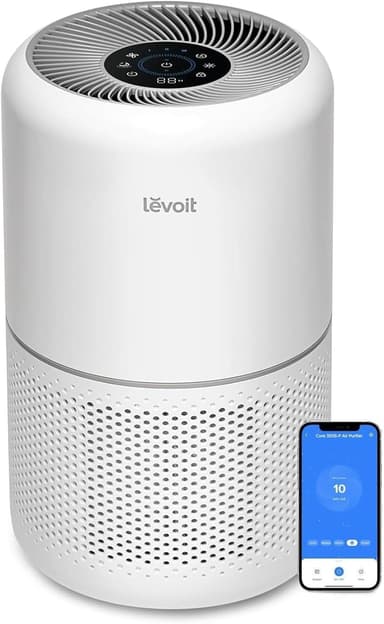
Levoit
Levoit Core 300S Smart Air Purifier
$99.99
Amazon's #1 bestselling air purifier with over 100,000 five-star reviews. True H13 HEPA filters 99.97% of 0.3-micron particles for rooms up to 219 sq ft, with whisper-quiet sleep mode and VeSync app control.
- Amazon's #1 bestselling air purifier with 100K+ reviews
- True H13 HEPA removes 99.97% of 0.3-micron particles
- Whisper-quiet at 24 dB in sleep mode
As an Amazon Associate we earn from qualifying purchases. Prices updated regularly.
The Core 300S is the most consistently recommended bedroom purifier in this category for good reason: it hits the key bedroom criteria more cleanly than any competing unit at its price point. Sleep mode runs at 24 dB — quieter than a whispered conversation — and the display shuts off completely rather than just dimming. It uses genuine H13 HEPA filtration, which captures 99.95% of particles down to 0.1 microns, and the built-in PM2.5 laser sensor enables auto mode that responds to real-time air quality rather than running at a fixed speed.
The trade-offs are real: at 219 sq ft rated coverage, it's sized for a standard bedroom but will struggle in a 250+ sq ft room if you want to maintain 5 ACH at low speeds. The activated carbon layer is thinner than larger units, so it's less effective at VOC and odor reduction than, say, the Winix 5500-2. But for a 10×12 or 10×14 bedroom with primary concern being particles (dust, pollen, PM2.5 from outdoor infiltration), the Core 300S is a near-ideal fit. See our air purifiers for allergies guide for how it compares in allergy-specific contexts.
One note: the Core 300S does not have a dedicated sleep mode timer, so it runs continuously until manually changed. This is a feature, not a bug, for bedroom use — you want it running overnight, not shutting off at a programmed time while you're still asleep.
Best Overall for Medium to Large Bedrooms: Winix 5500-2
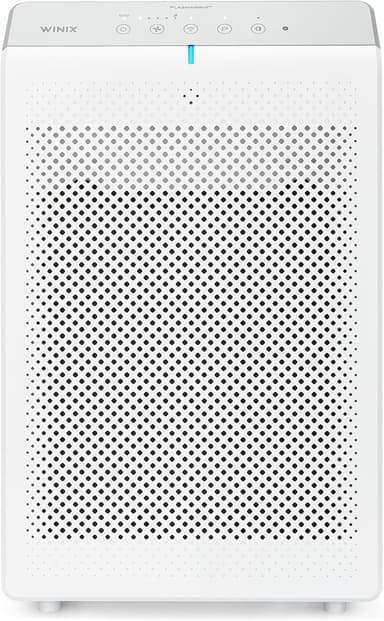
Winix
Winix 5500-2 Air Purifier
$179.99
True HEPA + washable pre-filter + activated carbon for rooms up to 360 sq ft. Includes PlasmaWave technology.
- Washable pre-filter (lower maintenance cost)
- Strong HEPA + carbon combo
- Auto mode with smart air quality sensor
As an Amazon Associate we earn from qualifying purchases. Prices updated regularly.
The Winix 5500-2 is the bedroom purifier most likely to satisfy users who want a single unit that handles the full range of bedroom air quality concerns: fine particles, VOCs from furniture and cleaning products, pet dander, and odors. Its four-stage filtration includes a true HEPA filter (rated to 0.3 microns at 99.97%), a substantial activated carbon/zeolite stage that outperforms the token carbon layers in most competitors, and a washable pre-filter that extends main filter life.
In sleep mode, the Winix 5500-2 drops to 27.8 dB and disables the display — within the acceptable range for most sleepers, though notably louder than the Core 300S. The PlasmaWave technology (an ionizing stage) should be turned off in bedroom use; the Winix team has stated it produces trace ozone at concentrations well below EPA limits, but for a bedroom where you're sleeping for 8 hours, disabling it is a reasonable precaution. With PlasmaWave off, you're running a straightforward HEPA + carbon unit that delivers strong results.
The 360 sq ft rated coverage at 4 ACH makes it appropriate for a 12×18 or 14×16 master bedroom. In a smaller 10×12 room, it will run more quietly and still more efficiently than a smaller unit — a good outcome. For bedroom-specific context on how this unit performs relative to pet dander and allergy triggers, our pet owner air purifier guide covers its dander performance in detail.
Best Budget Pick for Medium Bedrooms: Coway AP-1512HH Mighty
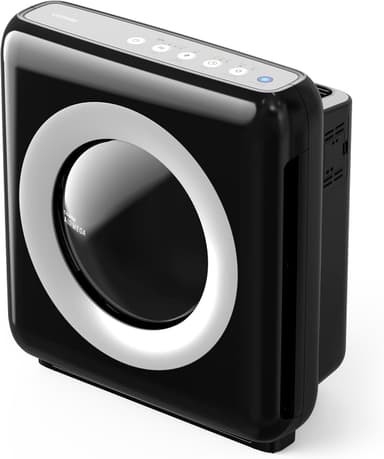
Coway
Coway AP-1512HH Mighty Air Purifier
$89.99
Best-selling 4-stage filtration air purifier for rooms up to 360 sq ft. True HEPA + activated carbon + ionizer.
- Exceptional value for HEPA filtration
- Auto mode with real air quality sensing
- Quiet operation (sleep mode)
As an Amazon Associate we earn from qualifying purchases. Prices updated regularly.
The Coway Mighty has maintained its popularity for years because it delivers true HEPA performance, a working auto mode with a real particle sensor, and a legitimate sleep mode — all for consistently under $100. For a bedroom where budget is the primary constraint, it's the obvious recommendation.
Sleep mode on the Coway runs at 24.4 dB, close to the Core 300S. The ionizer (like the Winix's PlasmaWave) should be disabled — the unit works fine without it. The display dims significantly in sleep mode and, on newer firmware versions, can be set to fully off via the button hold sequence. Coverage is rated at 360 sq ft, though real-world performance in bedrooms larger than 280 sq ft shows efficiency falling off compared to units with higher CADR ratings.
The Coway's primary weakness in a bedroom context is its auto mode — the sensor is less sensitive than the Core 300S's and can be slow to respond to transient particle events (a partner opening a window, cooking smells drifting from the kitchen). For a bedroom where you're primarily concerned about baseline overnight particle management rather than real-time responsiveness, this matters less than it would in a kitchen or living room. For allergy sufferers or those in high-particle environments, stepping up to the Winix or Core 300S's more responsive sensors is worth the additional cost.
Best for Large Master Bedrooms: Levoit Core 600S
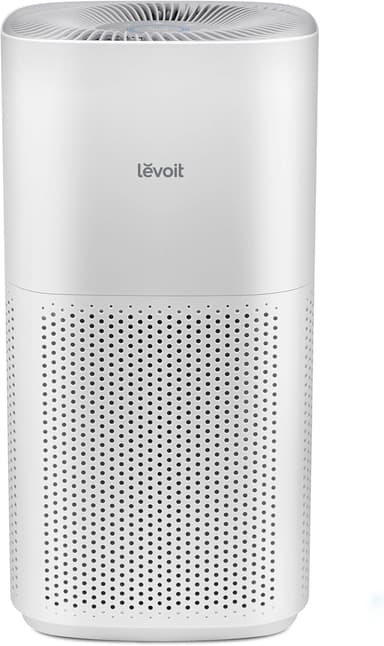
Levoit
Levoit Core 600S Smart Air Purifier
$279.99
Levoit's most powerful home air purifier for large spaces up to 635 sq ft. With a CADR of 410 CFM, built-in laser PM2.5 sensor, and auto-mode intelligence, the Core 600S is the go-to for open-plan living rooms and large bedrooms.
- 410 CFM CADR — covers up to 635 sq ft per cycle
- Built-in laser PM2.5 sensor for auto-mode intelligence
- True H13 HEPA with pet-allergen pre-filter
As an Amazon Associate we earn from qualifying purchases. Prices updated regularly.
For bedrooms larger than 300 square feet — master suites, open-plan sleeping areas, or rooms with high ceilings — the Core 600S provides the same H13 HEPA + carbon filtration and full display-off sleep mode as its smaller sibling, scaled to a 635 sq ft coverage area. In a 300 sq ft master bedroom, this means achieving 5+ ACH while running at speeds quiet enough for sleep, which is the practical goal.
At 26 dB in sleep mode, the 600S is marginally louder than the 300S — the larger motor necessary to move more air adds a small amount of mechanical noise — but still within the range most sleepers find comfortable. The PM2.5 and AQI sensor is the same laser-particle technology as the 300S and responds to transient air quality changes in 30–60 seconds, enabling the auto mode to ramp up and back down smoothly during overnight periods when windows are opened or odors drift between rooms.
If your bedroom is under 250 sq ft, the Core 600S is unnecessarily large and will run at its lowest speeds with very little of its capacity utilized. In that case, the Core 300S is the better fit. For rooms between 250–400 sq ft, either works, with the 600S providing more headroom and the 300S working harder. Above 400 sq ft, the 600S is the clear choice among the options in this guide. Our broader HEPA purifier selection guide walks through the CADR calculation if you want to work out the math for your specific room dimensions.
Placement, Runtime, and Practical Setup
Where to put it
Placement in a bedroom is more constrained than in a living room. The unit should be at least 3 feet from the bed to avoid drafts, and should not be placed directly in a corner (corners reduce airflow by 10–15% by restricting intake). On the floor near the room's air return or on a low dresser near the center of the room are both effective positions. Avoid placing it under a desk or against the wall behind the headboard — these positions impede the intake airflow most units draw from their sides or back.
Should you run it all night?
Yes. The purpose of a bedroom purifier is primarily overnight — running it only during the day misses the exposure window that matters most. On auto mode at low speeds, even a mid-sized unit draws 5–15 watts, adding roughly $2–5 to a monthly electricity bill. The cost of running it 8 hours overnight is trivially small compared to the benefit of consistently clean air during sleep.
Filter replacement cadence
Bedroom purifiers running continuously at low speeds typically require main filter replacement every 6–12 months, depending on local air quality and the size of your room. Many units display a filter replacement indicator; take this as a prompt to check the filter visually rather than an automatic replacement schedule. A filter in a low-pollution environment may last 14–16 months before performance noticeably degrades; one in a high-PM2.5 urban area may need replacement at 6–8 months. Weighing the filter (a clogged filter is measurably heavier) is a rough but effective indicator of how much particulate it has captured.
What About Air Quality Monitoring in the Bedroom?
A purifier handles filtration; a monitor tells you whether the filtration is working and flags conditions the purifier can't address (rising CO2 from poor ventilation, VOC spikes from new furniture, humidity issues). For a bedroom, the most useful metrics are PM2.5, CO2, and humidity. Our guide to indoor air quality monitors covers the full range of options; for a bedroom paired with one of the purifiers above, a mid-range monitor with CO2 and PM2.5 tracking provides a useful feedback loop on whether the auto mode is keeping pace with actual conditions overnight.
One common finding from bedroom monitoring: PM2.5 in bedrooms often spikes briefly when a door is opened (particles from the rest of the house entering) and recovers within 5–15 minutes as the purifier processes the air. Seeing this pattern in your monitoring app confirms that the auto mode is working as intended. If PM2.5 returns to baseline faster than 5 minutes after a door-opening event, the purifier may be oversized for the room — which is fine, just not necessary.
Frequently Asked Questions
Is it safe to run an air purifier while sleeping?
Yes — this is precisely what they're designed for. The main concern people raise is ozone, which some ionizer-based purifiers produce as a byproduct. The units recommended above are all mechanical HEPA + carbon designs, which generate no ozone. Running a true HEPA purifier in a bedroom overnight poses no health risks, and the evidence suggests it reduces them by keeping PM2.5 concentrations low during the high-exposure nighttime period.
How do I know if my bedroom air quality is a problem?
The symptoms of poor bedroom air quality — congestion, dry throat, fatigue on waking, frequent nighttime awakening — overlap with enough other causes that they're not reliable diagnostics on their own. The cleanest indicator is a PM2.5 monitor left in the bedroom overnight. If readings average above 12–15 µg/m³ or show regular spikes above 25 µg/m³, a purifier is likely to produce measurable improvements. Our guide to signs your indoor air quality is affecting your health covers the full symptom picture.
Does a bedroom air purifier help with snoring or sleep apnea?
Not directly — snoring and sleep apnea are structural/physiological issues that a purifier doesn't address. However, nasal congestion from allergens, dust, and PM2.5 exposure can worsen both, and reducing the particle load in the bedroom can reduce nighttime nasal inflammation for allergy and asthma sufferers. If your doctor has identified allergen sensitivity as a contributing factor, a bedroom purifier is a reasonable complementary measure alongside medical treatment — not a substitute for it.
Should I keep the bedroom door closed or open when running the purifier?
Closed is more efficient. A closed door limits the room volume the purifier has to treat and prevents particle influx from adjacent rooms. The trade-off is that CO2 from your breathing will accumulate faster in a sealed room. For most bedrooms, a 1-inch gap at the bottom of a closed door provides sufficient fresh-air exchange to keep CO2 below 1,000 ppm while still capturing most of the filtration efficiency benefits of a closed room. If you're monitoring CO2 and seeing levels above 1,200 ppm in a closed bedroom, either leave the door cracked further or improve whole-home ventilation before relying solely on a purifier.
What's the difference between a bedroom purifier and a nursery purifier?
The requirements overlap substantially — both prioritize quiet operation, display-off sleep mode, and H13 HEPA filtration without ionizers. Nursery-specific considerations include right-sizing for smaller room volumes (most nurseries are 100–180 sq ft), and the additional precaution of checking for radon in ground-floor rooms. Our dedicated nursery air quality guide covers the full setup. For adult bedrooms, the sizing requirements are typically larger and the VOC concern from new furniture applies primarily in the weeks after setup rather than continuously.
How loud is too loud for a bedroom air purifier?
Research on sleep disruption suggests that consistent tones above 35 dB in a bedroom begin to affect sleep architecture for light sleepers, while most people can sleep through 30–35 dB of white-noise-like sound. The real issue isn't the average dB level but the character of the sound: a variable fan that changes speed noticeably, a mechanical rattle, or a motor with tonal characteristics (hum at a specific frequency) is more disruptive than continuous broadband white noise at the same decibel level. This is why auto mode sensitivity matters in a bedroom — a unit that ramps from 24 dB to 45 dB repeatedly during the night is worse than one that settles at 30 dB and stays there.
The Bottom Line
For most bedrooms, the Levoit Core 300S is the cleanest solution: 24 dB sleep mode, full display off, H13 HEPA, and a responsive PM2.5 sensor — all in a unit that fits on a small dresser and runs for pennies overnight. If your room is larger than 220 sq ft or you want stronger odor and VOC control, the Winix 5500-2 scales up the same core features with a more capable carbon stage (just disable the PlasmaWave). Budget shoppers should give the Coway AP-1512HH Mighty a serious look — it delivers true HEPA performance and a genuine sleep mode at a price point that makes equipping multiple bedrooms practical. And for large master bedrooms over 300 sq ft, the Levoit Core 600S provides the same H13 filtration and display-off sleep mode as the 300S at the scale the room actually requires.
In all cases, the setup is the same: run it on auto, keep the filter current, and let it do its work through the night. The health case for clean bedroom air is well-supported, and the technology for achieving it is genuinely affordable. This is one of the few home air quality investments where the evidence clearly outpaces the marketing.